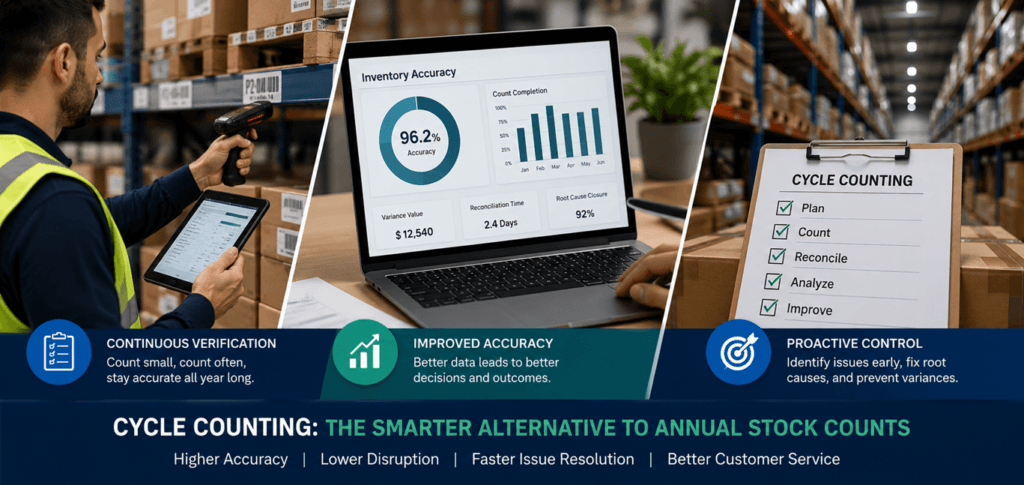
Introduction: Many organizations still rely on annual stock counts to verify inventory accuracy. The problem is simple, when inventory discrepancies are discovered only once per year, the root causes often remain hidden for months. By the time issues are identified, the operational impact may already include stockouts, excess inventory, production delays, or customer service failures.
Cycle counting offers a far more effective and operationally efficient alternative. Instead of shutting down warehouse operations for a large annual stock count, organizations continuously verify inventory throughout the year through scheduled counting activities.
The result is improved inventory accuracy, reduced operational disruption, faster issue resolution, and stronger supply chain reliability. Organizations focused on operational excellence increasingly treat continuous inventory auditing as a core inventory governance process rather than a compliance exercise.
Table of Contents
What Is Cycle Counting?
Cycle counting is a systematic process of counting selected inventory on a regular basis instead of counting the entire warehouse at once.
Rather than performing a full physical inventory annually, inventory is verified continuously throughout the year using predefined counting schedules.
Depending on inventory criticality and business requirements, items may be counted:
- Daily
- Weekly
- Monthly
- Quarterly
Cycle counting is widely used in modern warehouse and inventory management environments because it improves visibility while minimizing operational disruption. Cycle count results feed directly into an Inventory Health Assessment of your whole stock.
Organizations implementing effective inventory validation programs often achieve significantly higher inventory accuracy compared to traditional annual stock counts.
Four (4) Benefits of Cycle Counting
1. Improved Inventory Accuracy
Errors are identified and corrected before they accumulate into larger operational problems.
Frequent verification improves trust in inventory records and strengthens planning reliability.
2. Reduced Operational Disruption
Unlike annual stock counts, periodic inventory reviews does not require complete warehouse shutdowns or major business interruptions.
Operations can continue with minimal impact.
3. Faster Root Cause Analysis
Discrepancies can be investigated immediately while information remains fresh and operational conditions are still traceable.
This improves corrective action effectiveness.
4. Better Customer Service
Accurate inventory data supports:
- Better replenishment planning
- Improved order fulfillment
- Reduced stockouts
- Higher on-time delivery performance
Reliable inventory data ultimately improves customer satisfaction.
ABC Based Counting Strategy
Many organizations prioritize cycle counting using ABC inventory classification principles.
| Class | Priority | Recommended Count Frequency |
|---|---|---|
| A Items | High Value / High impact | Monthly |
| B Items | Medium Value / impact | Quarterly |
| C Items | Low Value | Semi-Annually |
This risk-based approach allows organizations to focus resources where inventory accuracy matters most.
For organizations seeking better inventory prioritization, understanding concepts like Economic Order Quantity (EOQ) can also improve inventory optimization strategies.
Read more:
https://safechainsol.com/blog/economic-order-quantity-eoq/
Common Causes of Inventory Variances
Organizations implementing cycle counting often uncover recurring operational issues such as:
- Incorrect receipts
- Picking errors
- Unrecorded inventory movements
- Unit of measure inconsistencies
- Master data errors
- Transaction timing issues
- Location inaccuracies
Without continuous monitoring, these problems can remain hidden for long periods and gradually reduce inventory reliability.
Cycle counting helps identify operational weaknesses before they become systemic business problems.
Best Practices for Effective Cycle Counting
Successful inventory verification programs require discipline, process ownership, and operational consistency.
Recommended best practices include:
- Establish standardized counting procedures
- Freeze inventory locations during counts
- Investigate variances immediately
- Track inventory accuracy KPIs regularly
- Focus on root cause analysis rather than blame
- Train warehouse teams consistently
- Use warehouse management system (WMS) controls wherever possible
Organizations with mature inventory management processes often integrate inventory verification into broader inventory governance frameworks. To improve inventory accuracy often we use Economic Order Economic Order Quantity (EOQ) methods to optimize replenishment decisions.
Measuring Success
Effective cycle counting programs are performance-driven.
Typical KPIs include:
- Inventory Accuracy %
- Count Completion %
- Variance Value
- Reconciliation Time
- Root Cause Closure Rate
- Adjustment Trends
- Repeat Variance Frequency
Monitoring these metrics helps organizations continuously improve inventory control performance over time. Businesses seeking better inventory control can also explore the inventory and supply chain resources available in Safe Chain Solver SC Tools.
Technology and Modern Inventory Control
Modern warehouse operations increasingly use technology to improve periodic inventory efficiency and accuracy.
Examples include:
- Barcode scanning
- RFID tracking
- Warehouse Management Systems (WMS)
- Mobile inventory applications
- Real-time inventory dashboards
Organizations using automated inventory technologies often achieve faster reconciliation and improved data accuracy.
Additional reference materials:
- APICS Inventory Management Best Practices: https://www.ascm.org/
- IBM Supply Chain Inventory Insights: https://www.ibm.com/topics/inventory-management
How Safe Chain Solver Can Help
Safe Chain Solver helps organizations:
- Design cycle counting programs
- Improve inventory accuracy
- Conduct inventory audits
- Resolve reconciliation issues
- Establish inventory governance processes
- Improve warehouse operational controls
- Strengthen supply chain visibility
Our approach focuses on practical, sustainable improvements that enhance operational reliability and decision-making accuracy.
Learn more at:
https://safechainsol.com/
Conclusion
Annual stock counts reveal problems. Cycle counting helps prevent them.
Organizations seeking world-class inventory accuracy should treat cycle counting as an ongoing operational discipline rather than a once-a-year event.
When implemented effectively, cycle counting improves inventory reliability, operational efficiency, customer service performance, and overall supply chain stability.
- Supply Chain Risk Management: Building Resilience in an Uncertain World
- How to Calculate Safety Stock: A Practical Guide for Pakistani SMEs
- Inventory Accuracy: The Hidden Profit Driver Pakistani SMEs Cannot Afford to Ignore
- Economic Order Quantity (EOQ): 4 Critical Mistakes to Avoid
- How to Measure Supplier Performance Using a Vendor Scorecard
- SLOB Inventory: Unlocking Hidden Working Capital