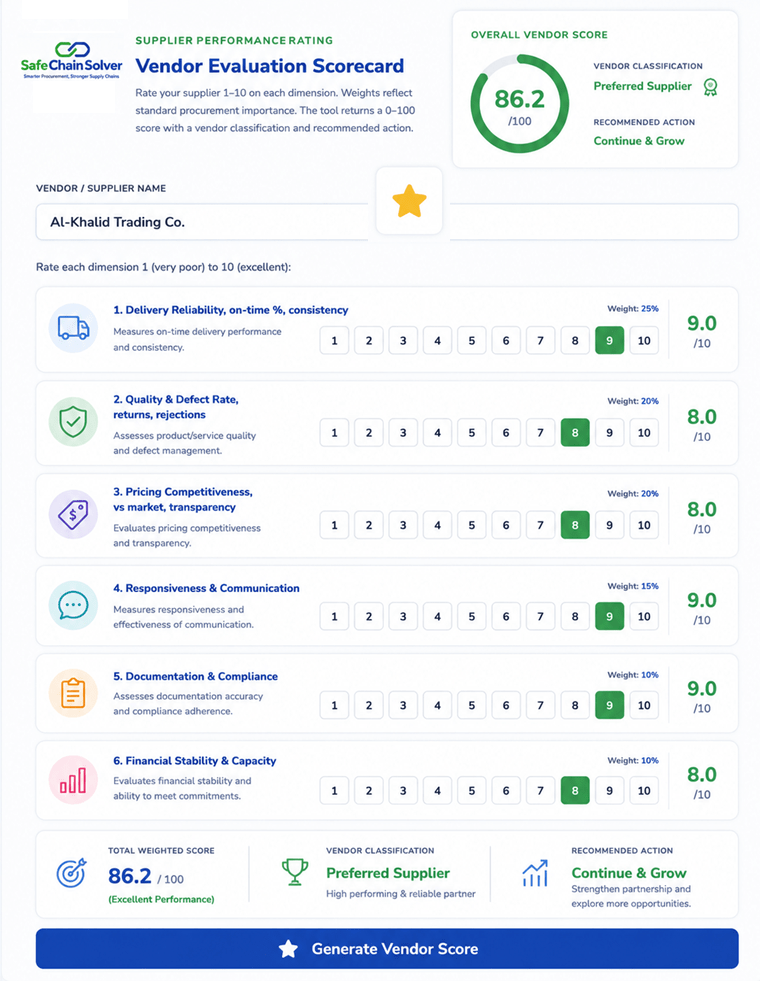
Introduction: A vendor scorecard is the most practical tool available for measuring supplier performance, and for most Pakistani SMEs, it is also the most underused. Many organizations invest significant effort in selecting suppliers but spend very little time measuring their ongoing performance. Without objective performance measurement, supplier-related issues often remain hidden until they affect operations, customer service levels, and profitability.
A Vendor Evaluation & Assessment provides a structured method for evaluating supplier performance, driving accountability, and supporting continuous improvement across your supply chain. Whether you manage five suppliers or five hundred, a consistent evaluation framework delivers measurably better procurement outcomes.
Use our free Vendor Scorecard Tool to score your suppliers across six weighted performance dimensions, instantly, no login required.
Table of Contents
What Is a Vendor Scorecard?
A Vendor Scorecard, also called a supplier scorecard is a performance management tool used to evaluate suppliers against predefined criteria. We feed these supplier scores into a Supply Chain KPI Dashboards so performance is visible in one place. A scorecard works best inside a wider Procurement Governance Framework that controls maverick spend.
It transforms subjective opinions and gut-feel assessments into measurable, comparable performance indicators. Rather than relying on informal relationships or historical preference, the scorecard gives procurement teams an objective foundation for supplier decisions.
The objective is to identify strengths, weaknesses, risks, and opportunities for improvement, across your entire approved vendor list, not just the suppliers that have recently caused problems.
According to Gartner, organizations with structured supplier performance management programs achieve significantly higher supply chain reliability than those relying on informal assessments.
Why Supplier Performance Matters
Poor supplier performance creates operational disruptions that compound quickly. A single late delivery can ripple through production schedules, inventory levels, customer commitments, and cash flow.
Poor supplier performance can result in:
- Production delays
- Inventory shortages
- Increased costs from emergency procurement
- Quality issues and product returns
- Customer dissatisfaction and lost business
Strong supplier management, on the other hand, improves operational stability, reduces supply chain risk, and builds the kind of long-term vendor relationships that deliver competitive advantage. Such evaluation framework gives procurement teams the visibility they need to act on supplier issues before they become operational problems.
For Pakistan and GCC SMEs operating with lean inventory buffers and limited working capital, supplier reliability is not optional. It is a survival requirement. Use our free Supply Chain Risk Assessment Tool to identify where your supplier dependencies create the greatest operational exposure.
Vendor Scorecard Metrics: Five (5) Key Supplier Performance Metrics
1. On-Time Delivery
Measures whether suppliers deliver according to agreed schedules and confirmed purchase order terms.
Consistent late deliveries create inventory shortages, force emergency procurement, and increase total supply chain costs. On-Time In-Full (OTIF) is the most widely used delivery metric in Pakistan’s industrial supply base.
Use our free OTIF Calculator to measure your suppliers’ delivery performance and identify which vendors are costing you the most in operational disruption.
2. Supplier Quality Scorecard
Evaluates supplier quality using defect rate, rejection rate, incoming inspection failures, specification compliance, customer complaints, and corrective action closure across incoming shipments.
Poor quality increases inspection costs, generates rework, delays operations, and introduces risk into production or customer-facing activities. A declining quality score can be an early indicator of supplier process weaknesses, capacity constraints, or inadequate quality controls upstream, allowing corrective action before problems escalate.Evaluates product quality, defect rates, and rejection frequency across incoming shipments.
3. Responsiveness
Measures how quickly suppliers respond to issues, inquiries, and change requests.
In fast-moving operational environments, supplier responsiveness can be as important as delivery performance. A supplier who delivers on time but takes five days to respond to a quality complaint is a higher operational risk than the numbers alone suggest.
4. Cost Competitiveness
Assesses pricing performance relative to market expectations, agreed contract terms, and total cost of ownership.
This is not simply about the lowest unit price. A supplier offering a lower unit cost but higher defect rates, longer lead times, or poor payment terms may have a higher total cost than a moderately priced alternative. Use our Procurement Savings Calculator to quantify the true cost impact of supplier performance differences.
5. Compliance and Risk
Evaluates regulatory compliance, business continuity capabilities, documentation standards, and risk exposure.
This dimension becomes increasingly important as organizations face greater scrutiny of their supply chains from customers, regulators, and financial institutions. Suppliers who cannot demonstrate compliance pose a risk that goes well beyond a single purchase order.
How to Score a Vendor Using a Scorecard (Use SafeChainSolver’s ScoreCard)
Vendor scoring converts supplier performance data into a clear, comparable rating.
Step 1: Define Evaluation Criteria – Select measurable factors such as quality, delivery, cost, and responsiveness.
Step 2: Assign Weights – Allocate percentage weights based on business priorities.
Step 3: Establish Scoring Ranges – Define consistent scoring standards, such as 1 to 5 or 1 to 10.
Step 4: Collect Performance Data – Use reliable purchasing, receiving, inspection, and delivery records.
Step 5: Calculate Weighted Scores – Multiply each score by its assigned weight and total the results.
Step 6: Review Ranking & Corrective Actions – Compare suppliers, identify weak areas, and initiate improvement actions where required.
Benefits of Vendor Scorecards
Organizations using structured supplier evaluations consistently outperform those relying on informal assessments.
Benefits include:
- Better supplier accountability through transparent, data-driven performance expectations
- Improved procurement decisions backed by objective historical performance data
- Reduced supply chain risk through early identification of declining supplier performance
- Stronger supplier relationships built on shared standards and clear communication
- Increased operational reliability by concentrating volumes with high-performing vendors
According to McKinsey & Company, procurement teams that use structured performance management frameworks achieve measurably better cost and reliability outcomes than those that do not.
Common Mistakes in Supplier Evaluation
Measuring Too Many KPIs
More metrics do not automatically produce better decisions. When every supplier interaction is scored across twenty dimensions, the result is often analysis paralysis, not improvement. Focus on the five to seven metrics that most directly drive business outcomes in your specific operating environment.
Inconsistent Evaluation Criteria
Suppliers should be assessed using transparent and standardized methods that apply equally across your vendor base. When scoring criteria shift between evaluations, or differ by evaluator, the results lose credibility, and suppliers lose trust in the process.
Ignoring Results
A scorecard that produces data but does not drive decisions is a waste of resources. Scorecards only create value when performance data drives action: supplier development conversations, volume reallocation, qualification reviews, or, where necessary, replacement.
Vendor Scorecards and Supply Chain Risk Management
Supplier performance and supply chain risk are closely connected.
A declining supplier score may indicate emerging risks that require attention before they affect customers. Financial instability, quality deterioration, or responsiveness problems often surface in scorecard trends weeks or months before they trigger an operational crisis.
Supplier’s performance & evaluation tools help organizations move from reactive supplier management, responding to problems after they occur, to proactive risk mitigation, identifying and addressing vulnerabilities before they affect operations.
For a complete picture of your supply chain risk exposure, combine regular performance score card reviews with our free Supply Chain Risk Assessment Tool, which scores your operation across twelve risk dimensions and produces a prioritized action plan.
Building a Culture of Continuous Improvement
A vendor scorecard is not a punishment tool. It is an improvement framework. When suppliers receive clear expectations, objective measurement criteria, and regular performance feedback, the relationship becomes more productive and mutually beneficial. High-performing suppliers appreciate the clarity. Underperforming suppliers gain a roadmap for improvement rather than an unexplained loss of business.
Organizations that build supplier evaluation into their procurement governance, not just as an annual exercise but as an ongoing management discipline, consistently achieve better performance, lower costs, and stronger supply chain resilience over time.
This approach also supports inventory accuracy improvement programs. Suppliers who deliver consistently, on time and to specification, eliminate the inventory uncertainty that forces organizations to carry excess buffer stock.
Conclusion
In today’s competitive business environment, supplier performance cannot be managed through assumptions or informal relationships alone.
Organizations that implement structured supplier assessment gain better visibility, stronger supplier relationships, and improved operational performance. The investment required is modest. The return, in reduced risk, lower costs, and more reliable operations, is substantial.
Use our free Vendor Scorecard Tool to score your suppliers across six weighted performance dimensions and build an objective, defensible approved vendor list. No login required.
For a broader operational review, request a Free Supply Chain Assessment from our founder, 21+ years of hands-on industrial supply chain leadership across Pakistan’s most demanding operational environments.