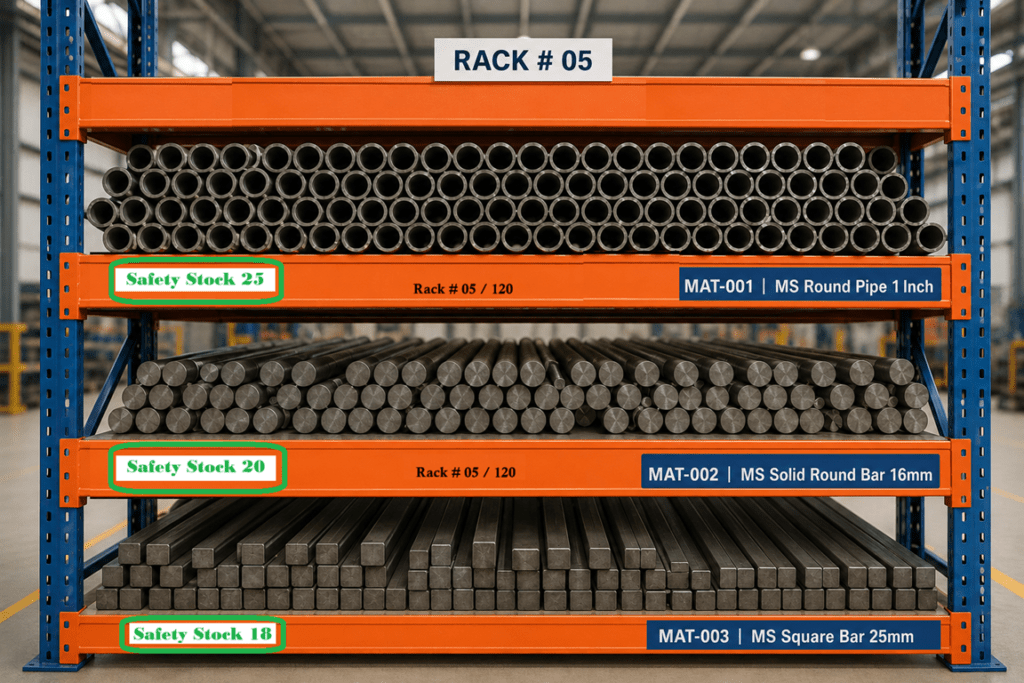
Introduction: Few business problems frustrate customers more than stockouts. Whether you run a manufacturing plant, distribution center, retail operation, or e-commerce business, running out of inventory can result in lost sales, delayed deliveries, unhappy customers, operational chaos and damaged reputation.
This is where safety stock becomes important. It acts as a buffer against uncertainty in demand and supply, helping businesses maintain service levels while minimizing inventory carrying costs.
Table of Contents
Many companies try to solve stockouts by simply carrying more inventory. While this reduces stockouts, it ties up valuable working capital and increases carrying costs. In this guide, we explain what safety stock is, why it matters, how to avoid common mistakes, and how Pakistani SMEs can calculate the right buffer inventory level for their operations.
What Is Safety Stock?
Safety, Buffer or Reserve stock is the additional inventory kept on hand to protect against unexpected fluctuations in customer demand or supplier lead times. It serves as a cushion that prevents stockouts when actual demand exceeds forecasts or when suppliers deliver later than expected.
According to the Association for Supply ChainManagement (ASCM), maintaining appropriate buffer stock is one of the foundational practices of effective inventory management. Without it, businesses become highly vulnerable to even minor supply or demand disruptions. Safety stock is only as good as your forecast, so see Demand forecasting techniques for SME’s for predicting demand more reliably.
Why Safety Stock Matters for Pakistani SMEs
Businesses face uncertainty every day, and Pakistani SMEs face additional challenges including supplier reliability issues, port delays, currency fluctuations, and inconsistent local transportation. Common causes of inventory uncertainty include:
- Unexpected increase in customer demand
- Supplier delays and lead time variability
- Transportation and logistics disruptions
- Production and quality issues
- Forecast inaccuracies
- Seasonal demand fluctuations
Without adequate buffer stock, even a small disruption can lead to significant operational challenges.
Benefits of maintaining appropriate stock buffer include:
- Improved customer service levels
- Reduced stockout frequency
- Better order fulfilment performance
- Increased business continuity
- Greater customer satisfaction and retention
Use our free Safety Stock Calculator to estimate the right buffer inventory level for your business in minutes.
The Cost of Too Much Buffer Stock
While insufficient stock buffer creates stockout problems, excessive stock buffer creates a different set of challenges. These include:
- Higher inventory carrying costs
- Increased warehouse space requirements
- Obsolescence and expiry risk
- Reduced cash flow and working capital
- Lower inventory turnover ratio
The goal is not maximum inventory. The goal is optimal inventory. Use our free Inventory Carrying Cost Calculator to understand exactly what your excess stock is costing your business in rupees every month.
A Practical Example
Consider a Pakistani distributor selling industrial spare parts.
- Average weekly demand: 100 units
- Supplier lead time: 3 weeks
- Peak period demand: up to 140 units per week
- Occasional supplier lead time: extends to 4 weeks
Without buffer stock, stockouts become highly likely during any combination of high demand and delayed supply. A carefully calculated buffer stock level absorbs these variations while maintaining customer service levels and avoiding emergency purchases at premium prices.
The Safety Stock Formula
The most practical formula for SMEs is:
Safety Stock = (Maximum Daily Usage x Maximum Lead Time) minus (Average Daily Usage x Average Lead Time)
For the example above:
- Maximum daily usage: 20 units, maximum lead time: 28 days = 560
- Average daily usage: 14 units, average lead time: 21 days = 294
- Safety Stock = 560 minus 294 = 266 units
Rather than calculating this manually, use our free Safety Stock Calculator which does this instantly once you enter your demand and lead time data.
Four (4) Common Buffer Stock Mistakes Pakistani SMEs Make
1. Guessing Inventory Levels
Inventory decisions should be based on data rather than assumptions or gut feel. Many Pakistani warehouse managers set buffer stock based on experience alone, without accounting for actual demand variability. This leads to either chronic stockouts or bloated inventory.
2. Ignoring Lead Time Variability
Supplier performance changes over time, especially with imported materials. Lead time variability should always be factored into your buffer stock calculation. A supplier who delivers in 21 days on average but sometimes takes 35 days requires a very different buffer than one who is consistently reliable.
3. Using the Same Reserve Stock for All Products
Fast-moving A-category products often require very different inventory policies than slow-moving C-category items. Use our free ABC Analysis Calculator to classify your inventory first, then set buffer stock levels accordingly.
4. Failing to Review Parameters Regularly
Market conditions change. Seasonal patterns shift. New suppliers come on board. Reserve stock calculations should be reviewed at least every quarter to remain relevant and accurate.
Safety Stock vs Reorder Point
Many people confuse these two related but different concepts.
Safety Stock is the additional inventory maintained as a buffer against uncertainty. It sits below your normal operating stock as a last line of defence against stockouts.
Reorder Point is the inventory level at which you should trigger a replenishment order. It is calculated as: Average Daily Usage x Lead Time, plus your Buffer Stock.
Both work together as part of an effective inventory planning strategy. Use our free Reorder Point Calculator alongside the Safety Stock Calculator to set up a complete replenishment system for your business.
According to a Investopedia guide on safety stock, businesses that implement data-driven reserve stock policies consistently outperform competitors on service levels and working capital efficiency.
How Technology Helps
Modern inventory management systems can automatically calculate and monitor buffer stock levels using historical demand and lead time data. Businesses that leverage data-driven inventory planning consistently achieve:
- Lower inventory carrying costs
- Higher customer service levels
- Improved forecasting accuracy
- Reduced emergency purchasing
Even without expensive software, our free SC Tools calculators give you the same analytical capability at no cost, built specifically for Pakistani and GCC SME operations.
Ready to Optimise Your Inventory?
If your organisation struggles with stockouts, excess inventory, or unreliable reorder decisions, reviewing your reserve stock policy can deliver immediate operational and financial benefits.
Use the Free Safety Stock Calculator
Request a Free Supply Chain Assessment
Conclusion
Safety stock is one of the most important tools for balancing customer service and inventory investment. When calculated correctly, it helps businesses remain resilient, responsive, and profitable. For Pakistani SMEs operating in an environment of supply uncertainty and demand variability, getting buffer stock right is not a luxury, it is a competitive necessity.