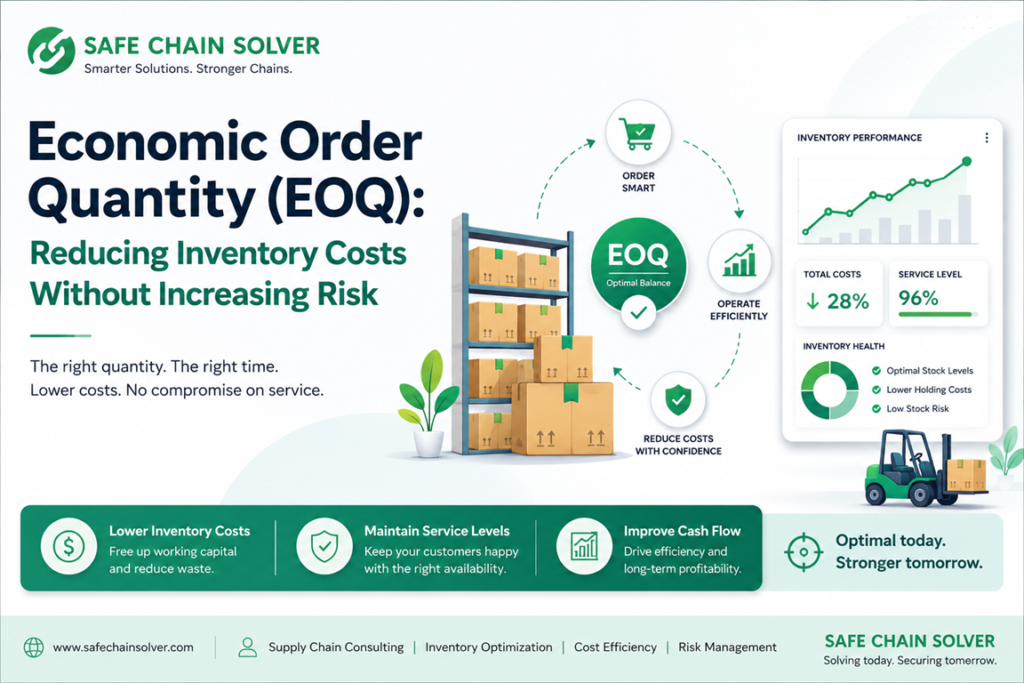
Introduction: Inventory is essential for business operations, but holding too much of it is expensive. Every business that orders and holds stock faces the same fundamental tension: order too little and your ordering costs climb. Order too much and your carrying costs rise. Finding the right balance is where most Pakistani SMEs lose money without realizing it.
Economic Order Quantity (EOQ) provides a structured, mathematically grounded approach to resolving this tension. It is one of the oldest and most proven concepts in inventory management, and it remains as relevant today as it was when first introduced. This guide explains what EOQ is, why it matters for SMEs across Pakistan and the GCC, and how to start applying it immediately using our free EOQ Calculator.
Table of Contents
What Is Economic Order Quantity (EOQ)?
EOQ stands for Economic Order Quantity. It is a widely used inventory management technique that identifies the ideal order quantity that minimizes total inventory costs by balancing two competing cost categories: ordering costs and inventory holding costs. EOQ assumes steady demand, so pair it with Demand forecasting techniques for SME’s to keep that assumption honest
According to Investopedia, EOQ is the point at which a company’s inventory costs, meaning the costs of ordering and holding stock, are at their lowest. It was originally developed by Ford W. Harris in 1913 and remains a cornerstone of operations management taught in business schools worldwide.
EOQ Formula (Wilson Formula): EOQ = √( 2 × D × S / H )
Where D = Annual Demand (units), S = Ordering Cost per order, H = Annual Holding Cost per unit.
🔧 Free Tool: Free EOQ Calculator , enter your demand, ordering cost and holding cost to get your optimal order quantity instantly. No login required.
Why EOQ Still Matters for Pakistani SMEs
Despite advancement in ERP systems and demand planning software, Economic Order Quantity remains relevant because every business, regardless of size or sector, seeks to balance inventory availability with cost efficiency. For SMEs operating with limited working capital and tight warehousing constraints, getting this balance wrong directly impacts cash flow and profitability.
Applying EOQ principles consistently delivers measurable benefits:
- Reduced total inventory costs through optimal order sizing
- Improved inventory planning and procurement discipline
- Better cash flow management by reducing overstocking
- More efficient procurement processes with fewer emergency orders
- Stronger alignment between ordering cycles and actual demand
For operations where inventory accuracy is already a concern, EOQ is most effective when combined with a structured inventory accuracy improvement program. Inaccurate stock records will produce misleading EOQ calculations.
Understanding the Two Inventory Cost Categories
Economic Order Quantity (EOQ) works by minimizing the sum of two cost categories that move in opposite directions as order quantity changes.
Ordering Costs
These are the costs incurred each time a purchase order is placed. They include:
- Purchase order processing and administrative overhead
- Supplier communication and negotiation time
- Transportation and freight coordination
- Goods receiving and inspection at the warehouse
As order quantity increases, ordering frequency decreases, so total ordering costs fall.
Inventory Holding Costs
These are the costs of keeping inventory in storage over time. They include:
- Warehousing space and utilities
- Insurance and security costs
- Inventory financing and opportunity cost of capital
- Obsolescence and spoilage risk
- Handling and shrinkage losses
As order quantity increases, average inventory on hand increases, so holding costs rise.
EOQ finds the order quantity where the total of these two costs is at its lowest. Use our Inventory Holding Cost Calculator to establish your actual annual carrying cost as a percentage of inventory value before running your EOQ analysis.
A Practical EOQ Example
Consider a manufacturing business in Karachi consuming 12,000 units of a critical component annually. Without EOQ, the procurement team orders based on intuition, supplier lead times, or available warehouse space. The result is inconsistent order quantities, variable cash commitments, and unpredictable carrying costs.
Applying EOQ with the following inputs:
- Annual Demand (D): 12,000 units
- Ordering Cost (S): PKR 2,500 per order
- Holding Cost (H): PKR 40 per unit per year
EOQ = √( 2 × 12,000 × 2,500 / 40 ) = approximately 1,225 units per order.
This means placing roughly 10 orders per year, rather than monthly or ad hoc orders, and the business holds a predictable average inventory that minimizes total cost. Plug your own numbers into our EOQ Calculator to produce this result instantly.
EOQ Within a Comprehensive Inventory Strategy
While Economic Order Quantity (EOQ) optimizes the order quantity decision, it works best as part of a broader inventory management framework. When combined with complementary techniques, it becomes significantly more powerful:
- Safety Stock, calculate your buffer inventory level to protect against demand variability and supplier lead time fluctuations.
- Reorder Point Planning, determine the exact stock level at which to trigger a new EOQ order so you never stock out.
- ABC Classification, classify your inventory and apply EOQ most rigorously to high-value A-class items where ordering discipline delivers the greatest financial return.
- Inventory Turnover Monitoring, track how quickly stock moves to validate that EOQ-driven ordering is reducing dead stock and improving working capital velocity.
All four calculators are available free on our SC Tools page, no login required.
Four (4) Common Economic Order Quantity Mistakes to Avoid
1. Ignoring Demand Changes
Economic Order Quantity (EOQ) is calculated from historical demand data. If your business is growing, seasonal, or subject to demand volatility, your EOQ should be reviewed quarterly. Using a static Economic Order Quantity on a dynamic demand pattern will produce suboptimal results. Where demand is genuinely unpredictable, supply chain risk management strategies become equally important.
2. Failing to Account for Supplier Constraints
Minimum order quantities (MOQs), supplier lead times, and volume discount thresholds may all affect your actual purchasing decision. EOQ gives you the optimal target, but supplier reality may require adjustments. Treat EOQ as the anchor and negotiate from there.
3. Treating EOQ as a One-Time Exercise
Business conditions change. Freight rates, holding costs, demand volumes, and supplier terms all shift over time. Inventory policies built on EOQ should be reviewed at least annually, and your ordering cost and holding cost inputs updated to reflect current operational realities.
4. Applying EOQ Without Accurate Inventory Records
Economic Order Quantity (EOQ) calculations are only as reliable as the demand data and cost inputs behind them. Organizations with poor inventory accuracy will produce unreliable EOQ outputs. Before investing in EOQ analysis, ensure your stock records are dependable. Read our guide on improving inventory accuracy if this is a current challenge.
When EOQ Works Best
EOQ is particularly effective in the following operating conditions:
- Demand is relatively stable or follows a predictable pattern
- Lead times from suppliers are consistent and measurable
- Ordering costs and holding costs can be accurately quantified
- Items are independently demanded and do not require joint ordering
- No strong seasonal peaks that require significant buffer inventory
It may require modification in highly volatile environments or where joint replenishment across multiple SKUs is more efficient. In those contexts, EOQ still serves as a useful planning baseline, and NetSuite notes that even approximate Economic Order Quantity application consistently outperforms intuition-based ordering.
Need Help Applying EOQ to Your Business?
Many organizations understand the EOQ concept but struggle to identify the right cost inputs or integrate the results into their procurement process. Safe Chain Solver works directly with SMEs across Pakistan and the GCC to apply inventory optimization frameworks, including EOQ, safety stock, and reorder point planning, in a practical, immediately implementable way.
Get a Free Operational Assessment
Conclusion
Economic Order Quantity remains one of the most practical and accessible inventory management techniques available. It does not require expensive software or complex implementation. It requires accurate cost inputs, reliable demand data, and the discipline to apply the result consistently.
Organizations that understand and apply EOQ principles regularly achieve lower inventory costs while maintaining reliable product availability. The combination of Economic Order Quantity with safety stock, reorder point planning, and ABC classification creates a comprehensive inventory optimization framework that any SME can implement.
Start now, use our free EOQ Calculator to estimate the optimal order quantity for your highest-volume inventory items, then explore the full suite of 15 free SC Tools to build a complete inventory optimisation picture.