Introduction:
Most business owners can tell you their monthly revenue without checking a single report. Very few can tell you, with any confidence, whether their inventory is actually under control. Stock sits in warehouses, gets counted once a year if at all, and only becomes a visible problem the day a customer order cannot be fulfilled or a warehouse audit turns up numbers that do not match the system.
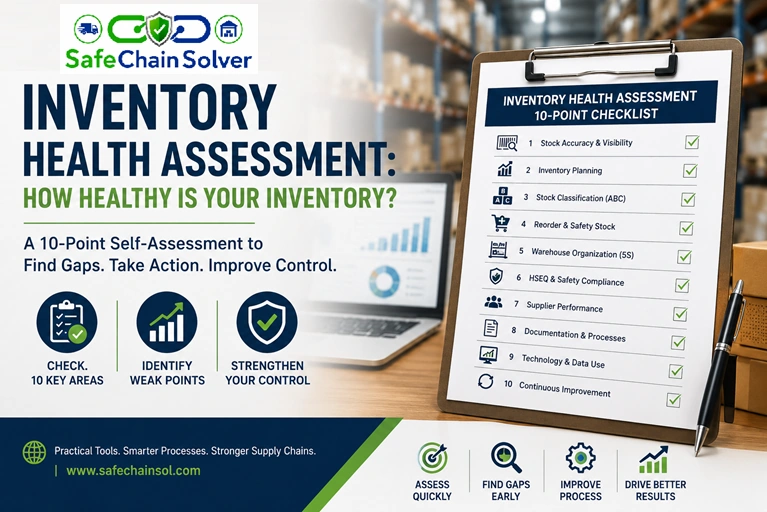
The good news is that an Inventory Health Assessment does not require a consultant’s visit to diagnose. A structured self-assessment, covering stock accuracy, warehouse discipline, and supplier control, can surface most operational gaps in about 30 minutes. This guide walks through the same 10 points we use with clients, so you can complete your own Inventory Health Assessment and score your operation before deciding whether outside help is needed.
Table of Contents
Why Inventory Health Assessment Gets Overlooked
Inventory problems rarely announce themselves. A 2 percent stock accuracy gap does not show up on a profit and loss statement. It shows up as a stockout three months later, or a rush order placed at a premium price because nobody trusted what the system said was on the shelf.
For most Pakistani and GCC SMEs, the real issue is not a lack of effort, it is a lack of a consistent measurement framework. Without one, teams manage inventory by instinct and firefighting, which works until it does not.
Stock Accuracy and Visibility – 4 Points
- Physical stock matches system records at least 95% of the time.
- ABC classification is used to prioritize inventory control. 3.
- Dead and slow-moving stock is regularly identified and reported. 4.
- Reorder points and safety stock levels are formally defined and reviewed.
This is the foundation everything else depends on. If your physical stock count does not match your system records at least 95 percent of the time, every other decision built on that data, reorder timing, safety stock levels, financial reporting, inherits the same error.
Two related questions matter here. First, do you have an ABC classification in place, so a fast moving, high value SKU gets more attention than something that sells once a year? Second, do you have a live report tracking dead and slow stock, since most businesses discover 10 to 25 percent of their inventory value is quietly tied up in stock that is not moving at all.
Our guide on how to calculate safety stock and our post on ABC analysis both go deeper into fixing gaps in this category.
For businesses implementing barcode-based inventory control, the GS1 global standards provide the foundation for accurate product identification and inventory traceability.
Warehouse and HSEQ Standards – 3 Points
- Warehouse locations are clearly labeled and matched to system records.
- 5S housekeeping and logical warehouse flow are consistently maintained.
- Fire safety, PPE, emergency access, and other HSEQ requirements are regularly checked.
Inventory accuracy problems often start on the warehouse floor, not in the system. A warehouse without a logical flow from receiving to dispatch, without documented 5S housekeeping standards, or without clearly labeled and system matched storage locations will generate mis-picks and search time no software can fix.
Health and safety compliance belongs in this same category. Blocked fire exits, missing PPE, or an outdated evacuation plan are not just compliance risks, they are also strong indicators that broader operational discipline is missing. Our post on warehouse 5S walks through how to build this discipline from the ground up.
Good warehouse practices are also supported by guidance from the National Institute for Occupational Safety and Health (NIOSH), which highlights safe material storage, clear aisles and passageways, and appropriate use of personal protective equipment.
Procurement and Supplier Control – 3 Points
- Key suppliers are formally scored on delivery, quality, price, and responsiveness.
- A documented procurement SOP and approval workflow are followed.
- Maverick buying and purchases outside approved processes are monitored and controlled.
The final category looks outward, at your supplier base. Are your top suppliers formally scored on delivery, quality, pricing, and responsiveness, or is supplier performance managed through memory and informal impressions?
A documented procurement SOP, with a clear approval workflow above a defined spend threshold, closes the loop. Without one, maverick buying quietly erodes both cost control and audit readiness. Our detailed guide on measuring supplier performance with a vendor scorecard covers this category in full.
How to Score Yourself
Score one point for every statement that is true for your organization today, not where you plan to be in six months. These 10 checks across three categories give you a practical picture of your overall inventory health.
Nine or 10 ticks means your operation is well controlled, and the priority becomes sustaining standards. Seven or 8 means solid foundations with a handful of clear gaps worth closing. Five or 6 signals real risk, often costing 5 to 12 percent of revenue in ways that never show up as a single line item. Four or fewer means the gaps are compounding daily and warrant urgent attention.
Common Mistakes When Self-Assessing
The most common mistake is scoring based on what a policy document says rather than what actually happens on the floor. A documented reorder point process that nobody follows consistently does not count as a tick.
The second mistake is treating the assessment as a one time exercise. Inventory health shifts as volume, suppliers, and staff change. A quarterly re-score catches drift before it becomes a crisis.
If your inventory health assessment highlights gaps, Safe Chain Solver has practical tools and guides to help you address them. Explore our inventory management resources for ABC Analysis, Safety Stock, Warehouse 5S, and Vendor Scorecards, or use our Inventory Health Checklist to assess your operation in more detail.
Conclusion
A 30 minute self assess, inventory health assessment will not only fix a broken inventory system, but it will also tell you, honestly, where to start. That is often the hardest part.
We built a free, downloadable version of this exact checklist, in both PDF and an interactive Excel format that scores itself automatically. Self-assess your inventory health here, no email required.
For a deeper, personalized review, our founder offers a Free Supply Chain Assessment, drawing on more than 21 years of hands on industrial leadership across Pakistan’s toughest operational environments.