Introduction
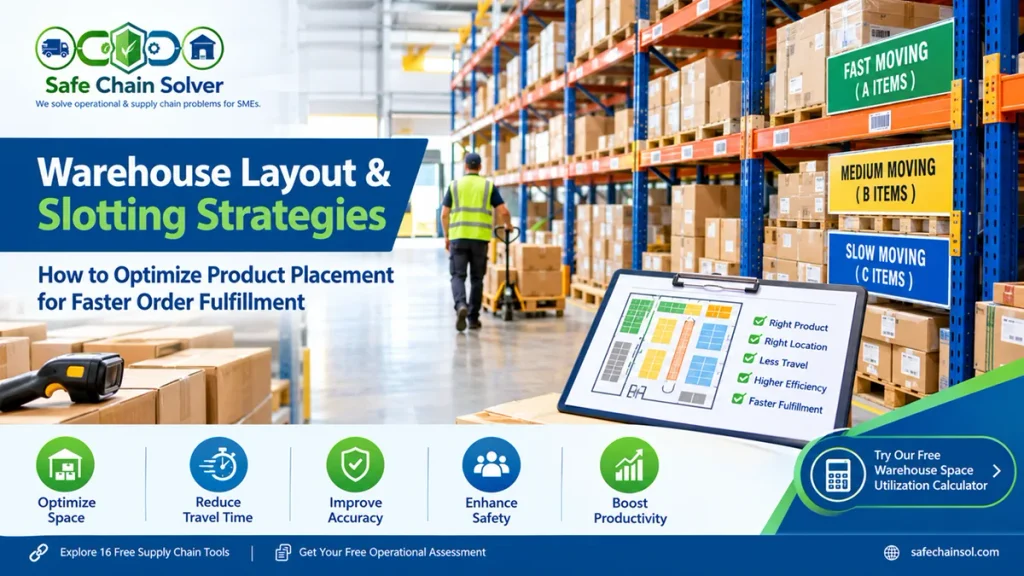
A warehouse can have adequate storage capacity and still operate inefficiently. Products may be difficult to locate, fast-moving items may be stored too far from dispatch, aisles may become congested, and employees may spend unnecessary time walking between storage and picking locations.
These problems directly affect order fulfillment, labor utilization, inventory accuracy, and customer service.
Warehouse layout and slotting strategies provide a structured way to address these issues. Instead of assigning products to storage locations randomly, businesses can determine where each SKU should be positioned based on movement frequency, product dimensions, weight, order patterns, handling requirements, and available space. Clear aisles and marked zones also support HSEQ Audit Readiness.
For SMEs, effective slotting can be particularly valuable because it can improve the use of an existing warehouse layout before management commits to additional storage space or expansion.
Table of Contents
Optimize Space and Travel Time with Strategic Warehouse Layout & Slotting
Warehouse slotting is the process of determining the most appropriate storage location for each product or SKU. The objective is not simply to put more inventory into the warehouse. A good slotting strategy should make products easier to access while supporting safe movement, efficient picking, accurate inventory records, and better use of available storage capacity.
The Warehousing Education and Research Council (WERC) includes slotting, storage and inventory control, picking and packing, and other warehouse activities among the areas used for operational benchmarking.
A practical slotting decision should consider:
- Product picking frequency
- Inventory turnover
- Product dimensions and weight
- Order frequency and quantity
- Products commonly ordered together
- Replenishment requirements
- Storage equipment
- Picking and dispatch locations
- Safety and ergonomic considerations
The result should be a warehouse where the products requiring the most frequent handling are positioned where they can be accessed efficiently.
1. Categorize Inventory by Velocity
Not every SKU should receive the same storage location.
Fast-moving products are normally picked more frequently, so unnecessary travel to distant storage locations can increase handling time. Slow-moving products, on the other hand, can often be stored in less accessible locations without creating the same operational impact.
An ABC analysis provides a useful starting point for prioritizing inventory. Businesses can combine ABC classification with actual picking frequency to determine which products deserve prime warehouse locations.
For example:
- A-items: High-priority products requiring frequent attention and control.
- B-items: Medium-priority products with moderate movement or value.
- C-items: Lower-priority products requiring less frequent handling.
However, value alone should not determine slotting. A high-value item may move very slowly, while a lower-value item may be picked hundreds of times each month.
For inventory prioritization and control, Safe Chain Solver provides a range of free SC Tools, including its ABC Analysis Tool. The site currently offers 16 free supply-chain calculators covering inventory, warehouse, procurement, logistics, and performance areas.
Practical slotting approach
- Place frequently picked items in convenient picking locations.
- Keep products requiring frequent replenishment accessible to warehouse staff.
- Move slow-moving stock away from prime picking positions where practical.
- Review SKU movement periodically rather than allowing locations to remain unchanged indefinitely.
2. Measure Warehouse Space Utilization Before Expanding
Before renting additional space or expanding a facility, management should determine how effectively the existing warehouse is being used.
Floor utilization alone does not provide the complete picture. A warehouse layout may have limited floor space available while still having significant unused vertical capacity.
Safe Chain Solver’s Warehouse Space Utilization Calculator measures both floor and cubic utilization and identifies unused floor space and the associated cost of that unused area. It also provides benchmarks and specifically recommends reviewing dead stock, racking configuration, and slotting before assuming more warehouse space is required.
Use the Warehouse Space Utilization Calculator to check your current warehouse utilization before making an expansion decision.
This is particularly useful for SMEs because warehouse rent and storage costs can represent a significant operating expense.
3. Design Ergonomic Picking Zones
Warehouse layout is also a workplace safety issue.
Frequently handled products should be positioned to minimize unnecessary bending, reaching, twisting, and awkward lifting. OSHA identifies lifting, lowering, bending, reaching overhead, pushing, pulling, and repetitive tasks among ergonomic risk factors relevant to warehousing.
For manually handled inventory, consider:
- Keeping frequently picked products within comfortable reach.
- Positioning heavier products where they can be handled safely.
- Avoiding unnecessary overhead lifting.
- Providing adequate aisle and working clearance.
- Keeping walkways and working areas free from obstructions.
- Ensuring racks and storage equipment are used within their rated capacities.
OSHA‘s warehousing guidance also addresses storage, material handling, powered industrial trucks, and workplace hazards.
Warehouse organization should therefore support both productivity and safe work practices.
Safe Chain Solver’s 5S Warehouse Management guide provides additional guidance on storage locations, labeling, aisles, housekeeping, standardization, and sustaining warehouse organization.
4. Group Complementary Products Together
Another important slotting principle is product affinity.
Order history can reveal products that are frequently purchased together. When practical, these products can be positioned within the same picking zone or in nearby locations.
For example, if customers regularly order Product A with Product B, storing the two products in distant areas may create unnecessary travel during order picking.
Warehouse managers can review:
- Frequently co-ordered products
- Common order combinations
- Average order size
- Picking frequency
- Seasonal demand patterns
- Product handling requirements
However, products should not be grouped together solely because they are frequently purchased together. Weight, dimensions, safety requirements, replenishment frequency, and storage compatibility must also be considered.
The objective is to create efficient picking routes without creating new congestion or handling problems.
5. Match Slot Size to Product Dimensions
Product dimensions are another important factor in warehouse layout & slotting.
A small product stored in a location designed for a much larger item can waste valuable storage capacity. Conversely, forcing a large or irregular product into an undersized location can create handling problems and increase the risk of damage.
Review:
- Product length, width, and height
- Carton dimensions
- Unit and case quantities
- Pallet configuration
- Product weight
- Packaging characteristics
- Required replenishment frequency
This is where cubic utilization becomes important.
A warehouse may have available floor space but still waste substantial vertical capacity. Similarly, storage locations may contain excessive unused space around products because the slot dimensions do not match actual product requirements.
For transport and container loading, Safe Chain Solver’s Cube Utilization Calculator can also help businesses understand how effectively available cubic capacity is being used.
6. Reduce Picking Travel and Warehouse Congestion
Travel distance is a major consideration when designing an efficient warehouse.
A poorly arranged facility may require employees to repeatedly cross the same aisles or travel between distant storage locations for individual orders. A better layout creates logical movement between receiving, storage, picking, packing, and dispatch.
Consider:
- Locating frequently picked products close to appropriate picking and dispatch areas.
- Creating logical picking routes.
- Separating pedestrian and equipment movement where necessary.
- Avoiding unnecessary crossing of high-traffic aisles.
- Scheduling replenishment activities to minimize interference with peak picking periods.
- Maintaining clear and properly marked aisles.
The objective is not necessarily to make aisles as narrow as possible. Higher storage density must be balanced against equipment requirements, accessibility, safety, and operational flow.
7. Protect Slotting with Accurate Inventory Records
Even a well-designed warehouse layout can fail if inventory records cannot be trusted.
If the system says a product is stored in one bin but the physical product is somewhere else, the warehouse employee still has to search for it. Repeated location errors can increase picking time, create stock discrepancies, and reduce confidence in inventory data.
Safe Chain Solver’s Inventory Accuracy guide explains how receiving, binning, picking, shipping, and unrecorded stock movements can contribute to inventory discrepancies.
Regular cycle counting can help identify location errors and verify whether the physical warehouse continues to match the inventory system.
The Cycle Counting guide explains how businesses can use regular counting rather than relying exclusively on an annual stock count.
Maintaining Layout Efficiency Over Time
Slotting should not be treated as a one-time warehouse project.
Demand changes. New products are introduced. Old products become slow-moving or obsolete. Seasonal demand changes picking patterns. Customer order combinations also evolve.
Warehouse managers should periodically review:
- Picking frequency
- Inventory turnover
- Travel distance
- Space utilization
- Picking accuracy
- Inventory accuracy
- Replenishment frequency
- Warehouse congestion
- Order fulfillment performance
When an item’s movement changes significantly, its storage location may need to change as well.
This is particularly important for slow-moving and obsolete inventory. Excess stock can consume valuable warehouse space and make it harder to position active products efficiently. A structured inventory review can therefore support both slotting optimization and working-capital improvement.
Measure the Results
Warehouse improvements should be measured rather than judged only by how organized the facility looks.
Useful KPIs include:
- Lines picked per labor hour
- Orders picked per labor hour
- Average picking travel distance
- Picking accuracy
- Order cycle time
- Space utilization
- Inventory accuracy
- Replenishment frequency
- On-time shipment performance
Comparing these indicators before and after a slotting exercise can show whether the changes are actually improving warehouse performance.
WERC’s benchmarking resources provide a framework for evaluating warehouse activities including picking, shipping, storage, inventory control, and order cycle performance.
Use Free Tools Before Making Major Warehouse Decisions
Warehouse managers do not always need expensive software or a major consulting project to identify their first improvement opportunities.
Safe Chain Solver provides 16 free supply-chain tools that can help SMEs examine different aspects of inventory and warehouse performance.
For this topic, particularly useful tools include:
- ABC Analysis for inventory prioritization
- Warehouse Space Utilization for floor and cubic capacity
- Cube Utilization for cubic space efficiency
- Inventory Accuracy for stock-record reliability
- Inventory Turnover for identifying slow-moving inventory
These tools can help management establish a starting point before deciding what operational changes are required.
When You Need a Broader Operational Review
Sometimes the warehouse layout is only the visible symptom.
An overcrowded warehouse may actually be caused by excess inventory. Slow picking may be connected to poor location control. Frequent stockouts may be related to inaccurate inventory records or weak replenishment policies.
Safe Chain Solver provides inventory optimization and warehouse improvement services covering inventory reconciliation, cycle counting, ABC-based stocking policies, warehouse operations, and related operational controls.
If you are unsure whether your main problem is warehouse space, inventory, layout, accuracy, procurement, or process control, you can request a Free Operational Assessment from Safe Chain Solver. The assessment is presented as a personalized supply-chain gap analysis with no cost and confidentiality.
Start Your Free Operational Assessment
Conclusion
An efficient warehouse layout is not simply about fitting more products onto racks. It is about putting the right products in the right locations for the way the warehouse actually operates.
A structured slotting strategy considers product velocity, dimensions, weight, order patterns, picking routes, safety, inventory accuracy, and available storage capacity. When these factors are considered together, businesses can reduce unnecessary movement, improve picking efficiency, support safer material handling, and make better use of existing warehouse space.
The process should also be continuous. Monitor SKU movement, measure warehouse KPIs, verify inventory accuracy, review space utilization, and re-slot products when operating conditions change.
Before investing in additional warehouse space, start by measuring what you already have. Use the Warehouse Space Utilization Calculator, review inventory priorities through ABC Analysis, check inventory accuracy, and examine cubic capacity.
If the results indicate a deeper operational problem, a Free Operational Assessment from Safe Chain Solver can help identify whether the underlying issue is inventory, warehouse layout, procurement, or broader supply-chain control.
For SMEs looking to improve fulfillment performance without immediately increasing physical capacity, better slotting and better operational discipline can be a practical place to start.
External references:
- Warehousing Education and Research Council (WERC) Warehouse benchmarking, slotting, storage, picking, and operational performance.
- OSHA: Warehousing – Hazards and Solutions Warehouse ergonomics, storage, material handling, and workplace safety guidance.