Introduction:
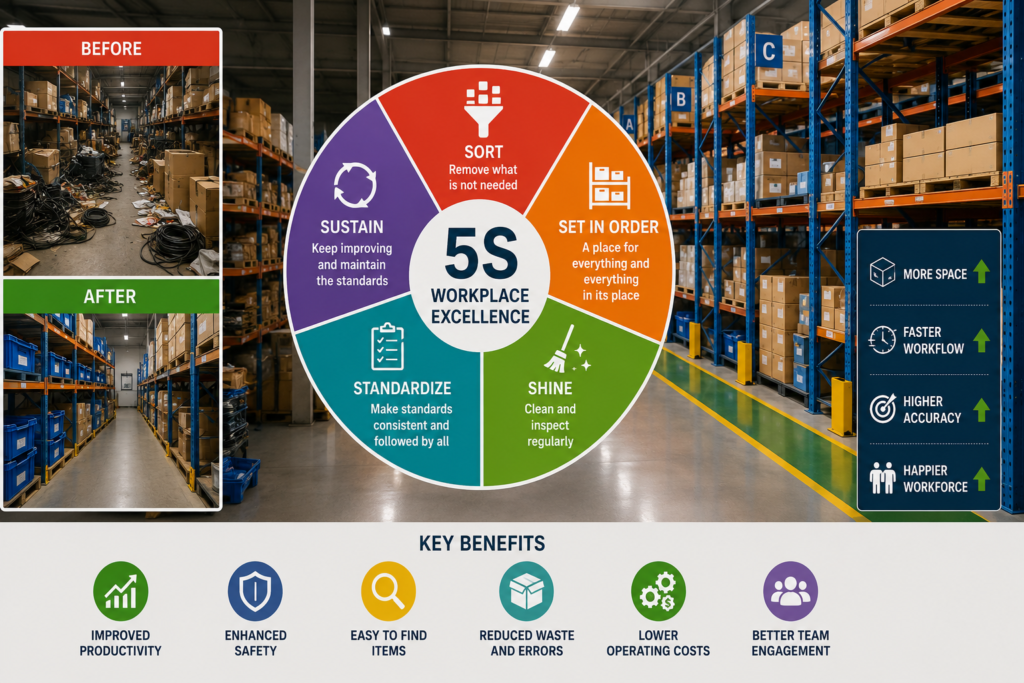
5S warehouse management is a workplace organization method used to improve warehouse efficiency, safety, cleanliness, and inventory control. Based on five principles Sort, Set in Order, Shine, Standardize, and Sustain. 5S helps warehouse teams reduce clutter, minimize searching time, improve storage discipline, and identify operational problems before they become costly.
For SMEs, implementing 5S does not necessarily require expensive technology or major facility changes. A structured approach to warehouse organization, visual controls, housekeeping, and regular audits can produce measurable improvements in daily operations.
This guide explains the five steps of 5S in a warehouse, how to conduct a 5S warehouse audit, which KPIs to monitor, and how technology can support long-term results.
Table of Contents
What Is 5S in Warehouse?
5S is a workplace organization methodology originating from Japanese Lean manufacturing principles.
The five elements are:
- Sort
- Set in Order
- Shine
- Standardize
- Sustain
Together, these principles help create a more efficient, disciplined and safe warehouse environment.
Why Warehouse Organization Matters
Poor 5S in warehouse organization creates hidden operational costs, including:
- Longer picking times
- Inventory discrepancies
- Increased safety risks
- Reduced productivity
- Higher training requirements
A well-organized warehouse improves both efficiency and employee performance.
5S Warehouse Audit: What to Check
A 5S Warehouse Audit evaluates workplace organization, cleanliness, safety, and adherence to established standards.
- Sort: Remove unnecessary, obsolete, or unused items from the warehouse.
- Set in Order: Ensure materials have defined storage locations, clear labeling, and easy accessibility.
- Shine: Maintain cleanliness while inspecting equipment, storage areas, and workspaces for issues.
- Standardize: Establish documented procedures, visual controls, and consistent workplace standards.
- Sustain: Conduct regular audits, assign accountability, and maintain 5S practices over time.
A warehouse 5S audit should check storage locations, labeling, aisles, equipment, housekeeping, safety hazards, and adherence to established standards. Regular audits help identify workplace inefficiencies, prevent unsafe conditions, improve space utilization, and maintain a disciplined warehouse environment.
Applying the Five Steps of 5S in Warehouse
1. Sort: Remove unnecessary materials, obsolete inventory, and unused equipment.
The objective is to eliminate clutter and free up valuable storage space.
2. Set in Order: Assign designated locations for inventory, tools, and equipment.
Clear labeling and location management reduce searching time and improve workflow efficiency.
3. Shine: Maintain a clean workplace through routine housekeeping activities.
Regular cleaning helps identify operational issues before they become larger problems.
4. Standardize: Create documented procedures for warehouse activities.
Standard work instructions improve consistency and reduce operational variability.
5. Sustain: Conduct regular audits and management reviews to ensure improvements remain in place.
Without ongoing discipline, warehouse performance often returns to previous habits.
How 5S Improves Warehouse Safety
5S improves warehouse safety by creating a more organized, visible, and controlled working environment. Clear aisles reduce congestion and allow employees and material-handling equipment to move safely. Removing unnecessary items helps reduce trip hazards, while proper storage prevents materials from being left in unsafe or unstable positions.
Clearly marked locations make it easier to identify where materials, tools, and equipment belong, reducing confusion and unnecessary movement. Keeping equipment visible and accessible also helps employees identify missing, misplaced, or potentially unsafe items quickly. Once the space is organized, warehouse teams can use Warehouse Layout & Slotting Strategies to position fast-moving inventory in locations that reduce travel and picking time.
Regular cleaning under Shine keeps work areas free from unnecessary debris and supports better housekeeping. Most importantly, an organized warehouse makes hazards easier to identify and address because abnormal conditions become more visible.
In this way, 5S supports safer warehouse operations while also improving efficiency, discipline, and workplace organization.
A 5S approach could address the situation as follows:
| 5S Step | Warehouse Action |
|---|---|
| Sort | Remove obsolete stock, unused equipment, and unnecessary materials |
| Set in Order | Assign locations and labels to inventory and equipment |
| Shine | Establish daily cleaning and inspection routines |
| Standardize | Document storage, labeling, and housekeeping standards |
| Sustain | Conduct regular audits and assign accountability |
Measuring Success of 5S in Warehouse
Beyond improving day-to-day operations, 5S Warehouse creates a culture of accountability and continuous improvement. Employees work more confidently in organized environments, supervisors spend less time resolving operational issues, and businesses benefit from improved customer service through faster order fulfillment, fewer inventory errors, and more reliable warehouse performance.
Organizations should monitor:
- Inventory Accuracy %
- Order Picking Accuracy
- Warehouse Space Utilization
- Safety Incident Frequency
- Picking Productivity
Performance measurement helps maintain momentum and identify improvement opportunities.
The Role of Technology
Technology can strengthen warehouse organization efforts.
Warehouse management solutions such as IBM Warehouse Management help organizations improve inventory visibility, optimize picking processes, and strengthen warehouse operations.
Barcode-enabled inventory systems and Microsoft Dynamics 365 Supply Chain Management support location control, inventory accuracy, and warehouse efficiency through digital warehouse management capabilities.
Learn more about Inventory Management Best Practices to strengthen inventory visibility and stock control. Technology is most effective when supported by strong warehouse processes.
Common 5S Warehouse Implementation Challenges
Many organizations encounter similar obstacles:
- Lack of leadership commitment
- Inconsistent audits
- Poor employee engagement
- Failure to document standards
5S warehouse management programs focus on culture, accountability, and continuous improvement rather than one-time cleanup activities.
Ready to Improve Warehouse Performance?
Safe Chain Solver helps SMEs improve warehouse organization, inventory control, storage processes, and operational efficiency through practical warehouse assessments and improvement programs.
Frequently Asked Questions About 5S Warehouse Management
What is 5S in a warehouse?
5S in a warehouse is a workplace organization methodology based on five principles: Sort, Set in Order, Shine, Standardize, and Sustain. It helps warehouse teams reduce clutter, improve organization, increase efficiency, and maintain safer working conditions.
Is 5S Just Warehouse Housekeeping?
No. Housekeeping is only one component of 5S.
What are the 5S steps in a warehouse?
The five steps are Sort, Set in Order, Shine, Standardize, and Sustain. Each step addresses a different aspect of warehouse organization and continuous improvement.
What is a 5S warehouse audit?
A 5S warehouse audit is a structured inspection used to evaluate organization, storage locations, labeling, housekeeping, safety conditions, visual controls, and compliance with established 5S standards.
How does 5S improve warehouse efficiency?
5S can reduce unnecessary searching, movement, clutter, and process variation. Clearly defined storage locations and standardized procedures can help employees locate materials and complete warehouse activities more efficiently.
How often should a warehouse conduct a 5S audit?
The frequency depends on warehouse size, activity, and operational risk. Many organizations use weekly or monthly checks, with more detailed management audits conducted periodically.
Does 5S improve inventory accuracy?
5S can support inventory accuracy by improving location identification, labeling, housekeeping, and storage discipline. However, inventory accuracy also depends on receiving, picking, counting, transaction recording, and inventory control processes.
Can SMEs implement 5S without expensive technology?
Yes. Basic 5S activities such as sorting, labeling, visual controls, housekeeping, standardized procedures, and regular audits can be implemented without sophisticated technology. Digital tools can be added later to improve visibility and control.
What KPIs should be used to measure warehouse 5S?
Useful measures can include inventory accuracy, picking accuracy, picking productivity, warehouse space utilization, safety incidents, housekeeping audit scores, and order fulfillment performance.
Conclusion
5S warehouse management provides a practical framework for improving organization, safety, inventory visibility, and operational efficiency. Its value comes not from a one-time cleanup, but from creating standardized processes and maintaining them through regular audits and accountability.
For SMEs, 5S can provide a practical foundation for broader warehouse improvements, including better space utilization, inventory accuracy, picking efficiency, and process control.
Safe Chain Solver helps SMEs assess and improve warehouse operations through practical inventory, warehouse, and process improvement solutions.