Introduction
Most SMEs discover the gaps in their HSEQ Audit Readiness, the same way during an audit, when a certification body or a major customer’s compliance team shows up and asks for documentation that doesn’t exist, or exists but hasn’t been updated in over a year.
HSEQ (Health, Safety, Environment, and Quality) compliance is frequently treated as a certificate to obtain rather than a system to maintain. That approach works right up until the surveillance audit, the customer site visit, or the incident that triggers a regulatory review, at which point the gap between “certified” and “compliant in practice” becomes very expensive very quickly.
Table of Contents
Why Certification Alone Isn’t Audit Readiness:
Achieving ISO 9001 or ISO 14001 certification proves your organization had a working system on the day of the certification audit. It says nothing about whether that system is still being followed six months later. According to ISO’s own guidance on the standard, ISO 9001 provides a framework for consistent quality and continual improvement, but the standard explicitly depends on ongoing internal audits and management review, not a one-time certification event, to remain effective.
Surveillance audits catch this gap constantly: corrective action logs that stopped being updated, safety walk through that were documented for the first quarter and then quietly abandoned, and training records that don’t reflect current staff.
The Four Documentation Gaps That Fail Audits Most Often
1. Corrective action tracking that dead-ends: Auditors don’t just check whether a nonconformity was identified — they check whether it was closed out with evidence. A corrective action log with open items from a year ago is one of the fastest ways to trigger a major nonconformity finding.
2. Training records that don’t match current staff: Turnover is normal in SME operations, but training documentation often isn’t updated when new employees join safety critical roles. An auditor asking a warehouse operator about a procedure they were never formally trained on is a common and avoidable failure point.
3. Risk assessments that were never revisited: A risk assessment done during initial certification and never updated after a process change, new equipment, or a near-miss incident no longer reflects actual operational risk, and auditors are specifically trained to probe for this gap.
4. Management review meetings that exist on paper only: ISO standards require documented management review of the HSEQ system at planned intervals. Meetings that happened informally, without minutes or action items, don’t satisfy this requirement even if the conversation genuinely took place.
Building a Practical HSEQ Audit Readiness Program
A sustainable HSEQ program doesn’t rely on a pre-audit scramble. It runs on a continuous, lightweight cycle:
– Monthly internal spot checks against a subset of the full audit checklist, rotating through different areas of the operation rather than reviewing everything at once
– A single owner per HSEQ pillar health, safety, environment, quality, accountable for keeping that pillar’s documentation current
– Corrective actions closed within a defined window, not left open indefinitely
– A living risk register updated whenever a process, equipment, or staffing change occurs, not just annually
This structure mirrors what a full external ISO 9001 audit evaluates, but breaks it into manageable pieces spread across the year rather than one high-stress event.
Leveraging Digital Tools for Better HSEQ Audit Readiness
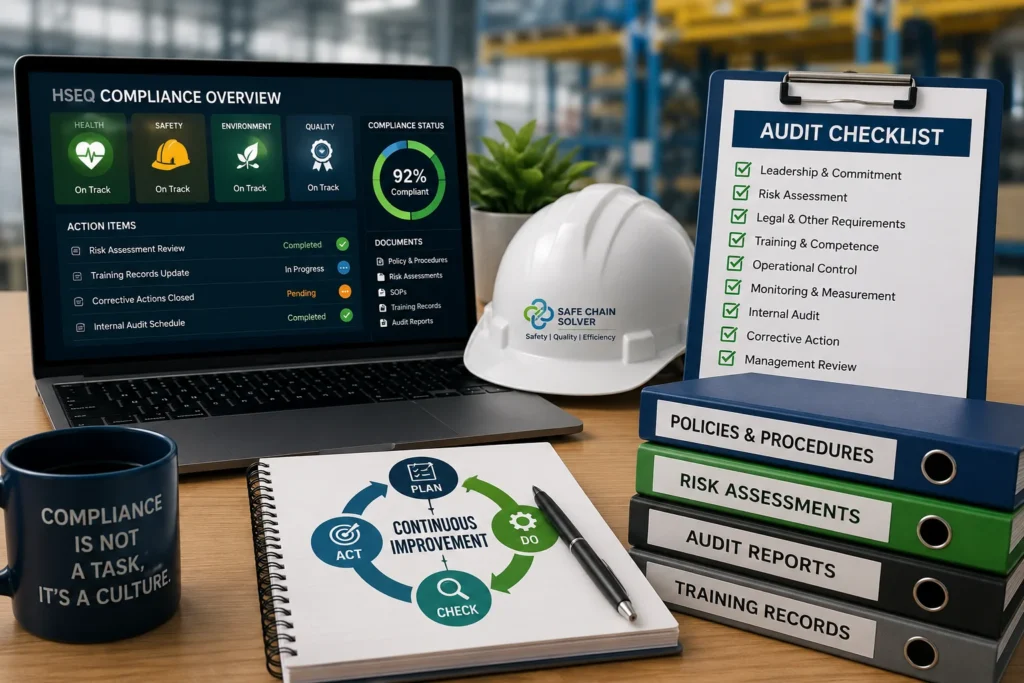
Modern SMEs can significantly improve HSEQ compliance by replacing scattered spreadsheets and paper files with simple digital tracking systems. Even affordable cloud-based document management, inspection checklists, and corrective action trackers make it easier to maintain version-controlled procedures, monitor due dates, and provide evidence during audits. Digital reminders also help ensure that training renewals, equipment inspections, and management reviews are completed on schedule. Instead of scrambling to collect documents before an audit, organizations can demonstrate a culture of continuous compliance where records are accurate, accessible, and regularly maintained. This proactive approach not only improves audit performance but also strengthens operational efficiency across the business.
Why This Matters Beyond Certification
For SMEs supplying larger corporates, in sectors like power, manufacturing, and construction, HSEQ Audit Readiness compliance increasingly functions as a commercial gatekeeper rather than a purely regulatory one. Procurement teams at larger buyers routinely request HSEQ documentation as part of vendor qualification, independent of whether formal certification is required by law. An SME with audit-ready HSEQ documentation has a real competitive advantage in these vendor evaluations a dynamic closely connected to how buyers now measure supplier performance through structured scorecards.
How Safe Chain Solver Can Help
Safe Chain Solver supports SMEs across Pakistan and the GCC in building HSEQ audit readiness programs that hold up under real audit scrutiny, including:
– Gap analysis against ISO 9001, ISO 14001, and OHSAS-aligned requirements
– Corrective action frameworks with clear ownership and closure tracking
– Internal audit cycles designed to catch issues before external auditors do
– Documentation systems that stay current between certification cycles, not just around them
This work is closely connected to the operational discipline we bring to Inventory, Warehouse & HSEQ engagements, since safety and quality gaps are frequently rooted in the same undocumented processes that also drive inventory and warehouse inefficiency.
Common Mistakes SMEs Should Avoid
Many organizations unintentionally create audit risks by treating documentation as an administrative task instead of an operational responsibility. Delaying corrective actions, failing to review risk assessments after operational changes, using outdated document versions, and conducting internal audits only before certification visits are common mistakes that increase the likelihood of non-conformities. Building accountability into daily operations ensures compliance becomes part of the company culture rather than a last-minute exercise.
Conclusion
HSEQ Audit Readiness program isn’t built in the weeks before a surveillance visit, it’s built through a year round discipline of documentation, ownership, and follow through that makes the audit itself almost a formality. Organizations that treat HSEQ as an ongoing operational system, rather than a certificate to renew, consistently walk into audits with far less anxiety and far fewer findings.