Introduction
Many organizations view inventory as an asset. The reality, however, is that not all inventory creates value.
A significant portion of warehouse stock often consists of slow-moving, excess, or obsolete materials that quietly consume working capital, warehouse space, and operational attention.
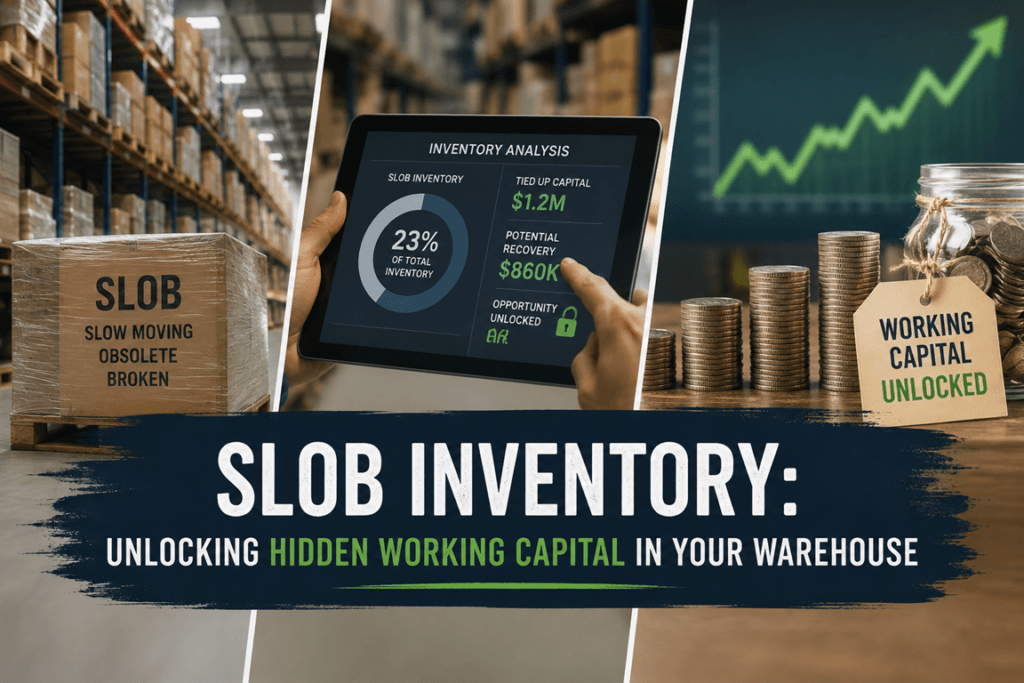
This category of inventory is commonly known as SLOB Inventory — Slow Moving and Obsolete Inventory.
For many businesses, SLOB inventory can represent 10% to 30% of total inventory value. Yet the problem frequently remains hidden until a warehouse capacity issue, financial review, or inventory audit exposes the operational impact.
Organizations seeking stronger inventory control often discover that improving inventory visibility is just as important as improving replenishment planning. Businesses facing broader inventory management challenges can also benefit from reviewing practical inventory optimization approaches such as Economic Order Quantity (EOQ).
Table of Contents
What Is SLOB Inventory?
SLOB Meaning in Supply Chain is Slow-Moving and Obsolete Inventory.
It refers to inventory that is not being consumed or sold at a healthy rate and therefore represents a growing financial and operational risk.
Slow-moving inventory is stock with very low or declining consumption, meaning it remains in storage for longer than the normal inventory cycle. Obsolete inventory is stock with little or no foreseeable demand, often due to product changes, discontinued items, technology upgrades, damage, or changes in customer requirements.
SLOB matters because excess inventory ties up working capital that could otherwise be used for procurement, operations, or business growth. It also consumes valuable warehouse capacity, increases handling and storage costs, and can lead to deterioration or write-offs.
Effective SLOB management involves identifying slow-moving items early, understanding the root cause, and taking corrective action before inventory becomes obsolete.
SLOB inventory refers to stock that:
- Has not moved for extended periods
- Experiences very low consumption
- Has become obsolete due to engineering or product changes
- No longer aligns with customer demand
Common examples include:
- Discontinued spare parts
- Legacy packaging materials
- Excess safety stock
- Project leftovers
- Expired or aging materials
SLOB inventory gradually reduces warehouse efficiency while increasing inventory carrying costs and operational complexity.
How to Analyze SLOB Inventory
Analyzing SLOB inventory requires reviewing key variables that reveal its financial and operational impact. Businesses should examine the last movement date, inventory age, consumption history, current quantity, inventory value, inventory turnover, carrying cost, obsolescence risk, and potential recovery or disposal value. Together, these factors help prioritize corrective actions.
Why SLOB Inventory Is Dangerous
1. Working Capital Gets Locked
Every dollar invested in inactive inventory is capital unavailable for business growth, expansion, process improvement, or operational investment.
Reducing non-moving inventory can significantly improve cash flow and financial flexibility.
2. Warehouses Become Congested
Excess inventory consumes valuable warehouse space that should support active operations and faster inventory movement.
Congested storage areas also increase material handling inefficiencies and picking complexity.
3. Inventory Accuracy Suffers
Dormant stock often contributes to reconciliation challenges, inventory inaccuracies, and location control issues.
Organizations improving inventory accuracy frequently implement stronger verification processes such as Cycle Counting Programs to identify inactive or misplaced inventory earlier.
4. Obsolescence Costs Increase
The longer inventory remains unused, the lower its recoverable value becomes.
In many cases, delayed action eventually results in write-offs or disposal costs.
Common Root Causes of SLOB Inventory
Most SLOB inventory problems originate from deeper operational and planning weaknesses such as:
- Poor demand forecasting
- Excessive safety stock levels
- Inaccurate master data
- Large supplier minimum order quantities (MOQs)
- Engineering or specification changes
- Weak inventory governance controls
- Lack of periodic inventory reviews
Organizations that fail to address root causes often see inactive inventory continue to accumulate over time.
A Practical SLOB Reduction Framework
Successful SLOB reduction requires a structured and data-driven approach.
Step 1: Classify Inventory
Segment inventory into categories such as:
| Inventory Category | Typical Condition |
|---|---|
| Active | Regularly consumed inventory |
| Slow Moving | Low consumption frequency |
| Excess | Higher than operational requirement |
| Obsolete | No future operational demand |
This classification creates visibility and prioritization.
Step 2: Quantify Exposure
Measure operational and financial impact including:
- Inventory value
- Storage utilization
- Inventory age profile
- Carrying cost exposure
- Disposal risk
This helps management understand the true scale of inactive inventory.
Step 3: Identify Root Causes
Avoid treating symptoms alone.
Organizations should determine why inventory became inactive in the first place.
This may involve reviewing:
- planning parameters
- procurement practices
- forecasting assumptions
- engineering changes
- warehouse controls
Step 4: Develop Recovery Actions
Potential recovery strategies may include:
- Internal redeployment
- Supplier returns
- Discounted liquidation sales
- Product bundling initiatives
- Controlled scrap disposal
The objective is to recover value wherever practical while preventing future accumulation.
Best Practices for Controlling SLOB Inventory
Organizations with mature inventory management practices typically:
- Conduct periodic inventory health reviews
- Monitor inventory aging regularly
- Improve forecasting accuracy
- Align procurement with operational demand
- Strengthen inventory governance processes
- Review safety stock parameters periodically
- Improve warehouse visibility and reporting
Supply chain resilience also depends heavily on proactive inventory management and operational visibility. Additional guidance on inventory and supply chain best practices can be found through ASCM (Association for Supply Chain Management) and IBM Supply Chain Insights.
How Safe Chain Solver Can Help
Safe Chain Solver supports organizations through:
- Inventory health assessments
- SLOB identification and analysis
- Inventory audits
- Root cause investigations
- Inventory optimization initiatives
- Warehouse operational improvement programs
Our approach focuses on practical and sustainable inventory improvements that support operational efficiency and better working capital utilization.
Conclusion
Inventory should support business growth not silently consume working capital and warehouse capacity.
A structured SLOB review often reveals major opportunities to improve cash flow, warehouse utilization, inventory visibility, and operational performance.
Organizations seeking stronger inventory control should treat SLOB reduction as an ongoing operational discipline rather than a periodic cleanup exercise.
For businesses looking to strengthen inventory governance and warehouse performance, visit Safe Chain Solver Contact Page.
Related Blog Posts
- Supply Chain Risk Management: Building Resilience in an Uncertain World
- How to Calculate Safety Stock: A Practical Guide for Pakistani SMEs
- Inventory Accuracy: The Hidden Profit Driver Pakistani SMEs Cannot Afford to Ignore
- Economic Order Quantity (EOQ): 4 Critical Mistakes to Avoid
- How to Measure Supplier Performance Using a Vendor Scorecard
- Cycle Counting: The Smarter Alternative to Annual Stock Counts