Introduction
Many SMEs reach a point where supply chain complexity has outgrown informal management, but the business is not yet ready to hire a full-time Supply Chain Director. Inventory losses increase, procurement decisions become inconsistent, warehouse performance remains unclear, and leadership lacks reliable operational visibility. Fractional supply chain leadership fills this gap by giving SMEs access to senior supply chain expertise on a part-time or retained basis, without the cost of a permanent executive hire. “This is the gap fractional supply chain leadership is built to close.”
Table of Contents
What Fractional Supply Chain Leadership Actually Means
A fractional supply chain leader is a senior operator, often with 20-plus years of industrial or utility sector experience, who works with your organization on a part-time, retainer, or project basis. He can put Procurement Governance in place without a full-time hire. He can oversight matters most during an ERP rollout, so see the SAP MM Implementation pitfalls to avoid.
According to a recent Harvard Business Review discussion on the model, fractional supply chain leadership lets organizations access senior-level judgment on demand rather than embedding it permanently, which is particularly relevant for functions that need direction and oversight without daily hands on management.
This is different from hiring a junior operations manager and different from a traditional management consultancy. A fractional leader sits closer to the business than a consultant typically does, but at a fraction of full-time executive cost.
The Cost Math SMEs Usually Get Wrong
Many SME owners default to one of two choices: hire a full-time supply chain manager, or keep muddling through with existing staff stretched across too many responsibilities. Both options carry hidden costs.
A full-time senior supply chain hire in Pakistan or the GCC typically takes several months to become fully productive, during which the organization is paying full salary for partial output. Meanwhile, understaffed operations quietly bleed money through dead stock, emergency procurement premiums, and warehouse inefficiency, costs that rarely show up as a single line item but add up significantly over a fiscal year.
Fractional supply chain leadership sidesteps both problems. You get senior-level judgement applied to your specific operational gaps, inventory governance, procurement structure, warehouse KPIs, at a cost structured around actual need, not a full annual salary and benefits package.
Beyond cost savings, fractional supply chain leadership accelerates operational maturity by introducing structured decision making, measurable KPIs, and accountability across critical supply chain functions. Instead of reacting to recurring problems, SMEs develop sustainable processes that improve inventory accuracy, procurement discipline, warehouse efficiency, and management visibility, creating a stronger foundation for scalable business growth.
Signs Your SME Is Ready for Fractional Leadership
– Inventory accuracy is below 90% and nobody owns the correction plan
– Procurement decisions bypass any formal vendor evaluation process
– Warehouse operations run on institutional memory rather than documented SOPs
– Leadership wants KPI visibility but has no one to design or maintain it
– The business has outgrown informal operations but isn’t ready for a full C-Suite hire
A Forbes Business Council analysis of the fractional leadership trend notes that the model works best when organizations start with the actual operational need rather than the job title, asking what specific function requires senior judgment, rather than assuming a full department must be built around it.
What a Fractional Supply Chain Leader Actually Delivers
Unlike a one time consulting engagement that ends with a report, fractional leadership is ongoing involvement structured around your operating rhythm, typically a set number of days per week or month, focused on:
– Diagnosing root causes behind inventory, procurement, or warehouse under performance
– Designing governance frameworks (vendor scorecards, reorder policies, audit cycles)
– Mentoring existing staff so capability stays in-house after the engagement matures
– Reviewing KPI dashboards and holding the operation accountable to targets
The goal is not dependency. A well-run fractional engagement transfers capability to your team over time, reducing the need for ongoing external oversight as internal maturity improves.
Fractional Supply Chain Leader vs. Supply Chain Consultant
| Fractional Leader | Traditional Consultant |
|---|---|
| Ongoing involvement | Often project-based |
| Works within operating rhythm | Provides recommendations |
| Helps implement governance | Usually delivers analysis |
| Coaches internal team | May have limited staff involvement |
| Accountable to ongoing KPIs | Engagement may end after report |
How to Start a Fractional Supply Chain Leadership Engagement
Phase 1 — Operational Diagnostic
Review inventory, procurement, warehouse, supplier performance and existing KPIs.
Phase 2 — Priority Identification
Identify the highest-impact operational risks and financial leakage.
Phase 3 — Governance Setup
Establish KPIs, vendor scorecards, inventory controls, SOPs and review routines.
Phase 4 — Leadership & Capability Transfer
Work with internal teams to implement improvements and build sustainable capability.
Not sure whether your business needs a full-time supply chain executive or fractional leadership? Start with a free operational assessment to identify your biggest inventory, procurement, warehouse and supplier performance gaps.
How Safe Chain Solver Can Help
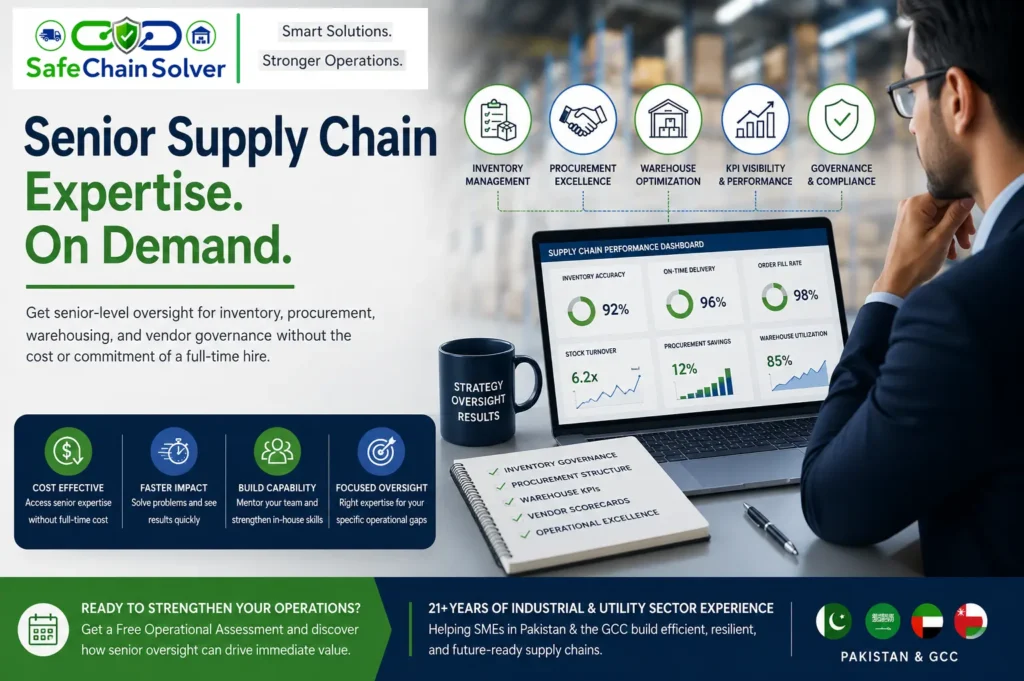
Safe Chain Solver offers Fractional Supply Chain Leadership as a core service for SMEs across Pakistan and the GCC who need senior-level oversight of inventory, warehouse, procurement, and vendor governance without the cost or ramp-up time of a full-time executive hire.
The engagements are founder-led, drawing on 21-plus years of industrial and utility-sector supply chain leadership, and are structured around your organization’s actual operational gaps rather than a fixed template. This complements our broader procurement and vendor management services for organizations that need deeper, function-specific support alongside fractional oversight.
Conclusion
Fractional supply chain leadership exists precisely for the SMEs caught between “too big to run informally” and “not big enough to justify a full-time executive.” It brings senior judgement to bear on the specific problems draining your margin, without the fixed overhead of a permanent hire.
If your operation has reached that inflection point, a free operational assessment is the natural first step to identify where senior oversight would have the most immediate impact.