Introduction
Most SMEs don’t fail at SAP MM implementation, because the software is wrong for them. They fail because the rollout is treated as an IT project instead of an operational one.
SAP Materials Management is one of the most powerful modules in the SAP ecosystem, covering procurement, inventory, and valuation in a single connected system. Done right, it eliminates the spreadsheet chaos that quietly drains margin from growing businesses. Done wrong, it becomes an expensive system that nobody trusts, running alongside the same manual workarounds it was supposed to replace.
For SMEs in Pakistan and the GCC, the stakes are higher than for large enterprises. There is usually no dedicated SAP Center of Excellence, no in-house Basis team, and no budget to redo the implementation eighteen months later. Getting it right the first time matters.
Table of Contents
Why SAP MM Implementation Projects Stall in SMEs
Unlike large enterprises with dedicated change management teams, SMEs typically run SAP MM implementation, lean one project sponsor, a small vendor team, and operational staff who are still expected to do their day jobs during go-live. That combination is exactly where the following mistakes tend to surface.
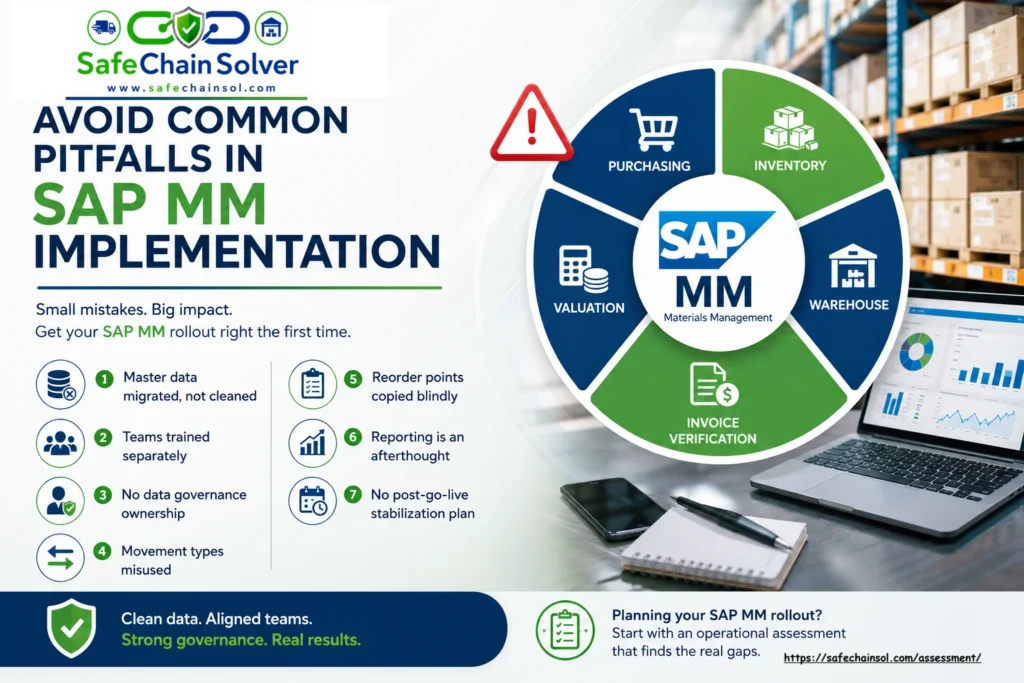
1. Master Data Is Migrated, Not Cleaned
The single biggest driver of SAP MM Implementation failure is dirty master data carried over from the legacy system. Duplicate material codes, inconsistent units of measure, and missing valuation classes don’t disappear when you move to SAP they multiply, because SAP enforces structure that the old spreadsheet never did.
Before go-live, every material master record should be reviewed, deduplicated, and standardized against a single naming convention. Skipping this step is the fastest way to end up with a system nobody trusts within the first quarter.
2. Purchasing and Warehouse Teams Are Trained Separately
SAP MM’s purchase-to-pay cycle only works when purchasing, receiving, and warehouse teams operate on the same transaction logic. When training is delivered in silos, receiving clerks post goods receipts against the wrong purchase order line, and reconciliation breaks down within weeks.
Joint, process-based training walking the full requisition-to-payment cycle as one team consistently outperforms module-by-module training split by department.
3. No One Owns Data Governance After Go-Live
Every SAP MM implementation needs a long-term owner for master data governance. Many SMEs assign a project team for SAP MM Implementation, then disband it the moment the system goes live. Without a named data owner for materials, vendors, and purchasing info records, data quality decays steadily from day one.
A lightweight governance structure, even one person reviewing new material and vendor master creation weekly prevents the slow drift back toward the disorganized data the project was meant to fix. This mirrors broader SAP master data governance best practices, which consistently point to unclear ownership, not lack of tooling, as the root cause of data decay after go-live.
4. Movement Types Are Misused
SAP MM offers dozens of movement types for goods receipts, issues, and transfers, and SME teams often default to two or three generic ones out of habit. This flattens reporting: management can no longer distinguish between a return to vendor, an internal transfer, and a scrap write off, because they’re all recorded the same way.
5. Reorder Points Are Copied from the Old System
Reorder points and safety stock levels built for a manual system rarely make sense inside SAP MM’s automated MRP logic. Carrying them over unchanged usually produces either chronic stockouts or bloated safety stock, the same problem the ERP investment was meant to solve. This is closely tied to how safety stock levels are calculated in the first place; if that calculation was never rigorous, SAP MM will simply automate a flawed number faster.
6. Reporting Is an Afterthought
Reporting should be planned during the SAP MM implementation, not after go-live. Teams often go live focused entirely on transactional processing, then scramble to build reports once management asks for visibility. SAP MM standard reports (MB52, ME2M, and others) should be mapped to specific KPIs, inventory accuracy, purchase order cycle time, emergency purchase ratio before go-live, not after.
7. There Is No Post-Go-Live Stabilization Plan
The first 60 to 90 days after go-live determine whether SAP MM becomes the system of record or gets quietly bypassed. SMEs that skip a formal stabilization phase daily transaction review, error log monitoring, rapid user support tend to see shadow spreadsheets creep back in within the first month.
How Safe Chain Solver Can Help
Safe Chain Solver supports SAP MM rollouts and post-implementation stabilization through:
– Master data cleansing and standardization before migration
– Movement type and reporting design aligned to real KPIs
– Joint process training across purchasing, receiving, and warehouse teams
– Post-go-live governance frameworks that keep data clean long-term
Our approach is grounded in hands-on SAP MM experience across utility and industrial operations, not generic consulting frameworks.
Conclusion
A successful SAP MM implementation is built on clean data, disciplined governance, and operational ownership, not just software configuration. SAP MM is not a plug-and-play system, and treating it as one is the single most common reason SME implementations underdeliver. The businesses that get real value from SAP MM are the ones that invest in clean data, joint training, and disciplined governance before, during, and after go-live.
If your organization is planning a SAP MM implementation or has one that isn’t delivering the visibility it promised, a structured operational assessment is the fastest way to identify where the gaps are.