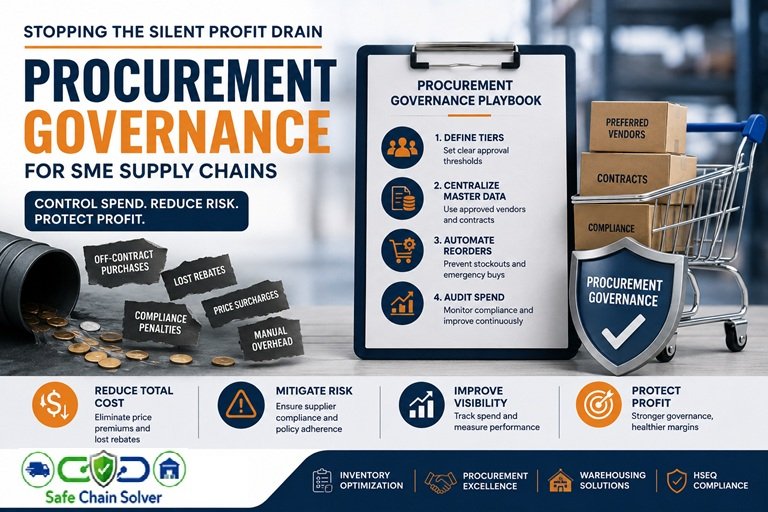
Introduction: Effective Procurement Governance helps SMEs stop hidden profit leakage by controlling off-contract purchasing, strengthening supplier compliance, improving spend visibility, and ensuring every purchase supports the organization’s cost, inventory, and operational objectives.
Table of Contents
Procurement Governance provides the framework SMEs need to control purchasing decisions, enforce supplier agreements, and prevent unauthorized spending from quietly eroding profitability.
The Hidden Cost of Off Contract Purchasing
Uncontrolled purchasing is one of the most pervasive operational leaks in mid sized supply chains. When department heads, site managers, or field operators make independent purchasing decisions outside established vendor contracts, the organization suffers far more than immediate price surcharges. Off contract spending breaks procurement strategy, distorts demand planning, and introduces severe supplier compliance risks.
Many operations leaders assume that maverick buying is simply a minor nuisance involving occasional emergency orders. In reality, purchasing without centralization systematically erodes gross margins across every tier of the business.
Total Maverick Spend Impact = (Price Premiums) + (Lost Rebates) + (Administrative Overhead) + (Compliance Penalties)
Why Bypassing Procurement Contracts Costs 25 Percent More
When employees purchase goods without contract coverage, they forfeit pre negotiated pricing tiers and volume rebates. These spot purchases carry heavy financial penalties:
- Direct Surcharges: Off contract items routinely carry standard list price surcharges ranging from 15 to 30 percent above negotiated enterprise rates.
- Administrative Overhead: Processing rogue invoices requires manual matching, custom approval routing, and specialized accounting reconciliation, which inflates process costs by up to 40 percent per invoice.
- Lost Volume Leverage: Bypassing preferred vendors reduces aggregated purchasing volume, weakening your team during annual contract renegotiations.
According to procurement operational guidelines from the Chartered Institute of Procurement & Supply, organizations that enforce centralized purchasing rules reduce total indirect spend by an average of 15 percent within six months.
Strategic Causes of Maverick Spend in Growing Companies
To eliminate unauthorized buying, operations leaders must address the root operational failures that push teams toward non compliant vendors.
+———————————————————————–+
| ROOT CAUSES OF MAVERICK PURCHASING |
+———————————–+———————————–+
| Operational Bottlenecks | Systemic visibility Gaps |
+———————————–+———————————–+
| * Slow requisition approvals | * Unclear preferred vendor lists |
| * Frequent inventory stockouts | * Poor inventory replenishment |
| * Unclear spend thresholds | * Lack of real time spend tracking|
+———————————–+———————————–+
Inefficient Requisition Approvals
When internal purchasing processes take days or weeks to approve simple requisitions, team leads take matters into their own hands. If a maintenance manager needs a critical replacement part to keep a production line running, they will use a personal credit card or an unauthorized local supplier rather than wait for corporate approval.
Stockouts and Inaccurate Reorder Points
Maverick buying is frequently a symptom of stockouts. When stock levels drop below operational thresholds without warning, plant managers make emergency purchases at inflated spot rates to maintain output.
A Four Step Procurement Governance Playbook for SMEs
Effective Procurement Governance does not mean burying your team in corporate red tape; it creates practical controls that maintain purchasing agility while enforcing financial and operational discipline.
[1. Define Tiers] —> [2. Centralize Master Data] —> [3. Automate Reorders] —> [4. Audit Spend]
Step 1: Establish Tiered Approval Thresholds
Define precise spending thresholds so low risk items move quickly while high value purchases undergo rigorous evaluation:
- Micro Purchases (Under $500): Pre approved catalogs with automated monthly spend caps.
- Standard Operational Purchases ($500 to $5,000): Require local manager sign off and preferred vendor selection.
- Capital Expenditures (Over $5,000): Require formal procurement review, competitive bidding, and executive approval.
Step 2: Centralize Vendor Master Data and Contract Access
Ensure every department head has clear access to the pre approved supplier directory. If employees do not know who the contract supplier is, they will default to local retail options.
Step 3: Automate Inventory Replenishment Triggers
Stop emergency purchasing before it happens by fixing your inventory metrics. Calculate precise safety buffers with our Safety Stock Calculator and set optimal replenishment schedules using our Reorder Point Calculator.
Step 4: Track Spend Visibility and Operational Metrics
Review unapproved purchases during monthly operational meetings. Build clear visual reporting systems using our guide to Building Supply Chain KPI Dashboards to track compliance across departments.
Integrating Governance into Your Operational Culture
For Procurement Governance to deliver lasting results, purchasing controls must become part of the organization’s everyday operating culture rather than remain a set of policies that employees follow only during audits.
Long term compliance relies on giving teams clear guidelines and practical leadership rather than imposing strict rules.
Bridging Leadership Gaps
Governance programs fail when leadership lacks time or expertise to oversee purchasing workflows. When internal bandwidth is limited, bringing in external expertise through Fractional Supply Chain Leadership helps establish spend policies without increasing full time overhead.
Measuring Governance Maturity
Regularly measuring Procurement Governance maturity helps leadership identify spend leakage, approval weaknesses, supplier compliance gaps, and opportunities to strengthen purchasing controls.
To identify spend leaks across your operation, run a complete diagnostic using our Free Operational Assessment. You can also cross reference industry governance benchmarks provided by the Supply Chain Management Association to align your procurement rules with international standards.
Conclusion:
Strong Procurement Governance does not have to slow an SME down; it creates the controls needed to buy faster, smarter, and more consistently. By addressing maverick spend, improving inventory triggers, centralizing supplier data, and monitoring compliance, SMEs can protect margins, strengthen supplier relationships, and build a more disciplined, scalable procurement operation for sustainable growth.