Introduction
Fleet costs rarely fail loudly. They fail quietly, one deferred oil change and one unmonitored fuel card at a time, until the annual running cost number lands on someone’s desk and nobody can explain why Preventive Maintenance & Fuel Monitoring 20% higher than last year.
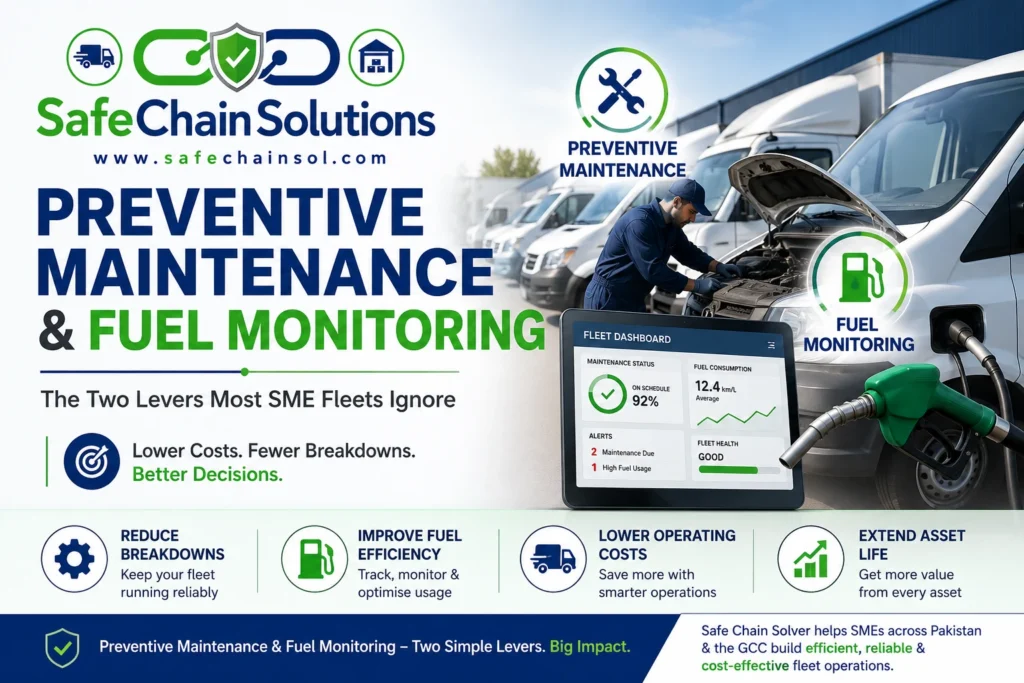
For SMEs operating delivery vehicles, forklifts, generators, or a mixed industrial fleet, two operational levers, preventive maintenance & fuel monitoring, consistently separate well-run fleets from expensive ones. Neither requires large capital investment. Both require structure that most SME fleets simply don’t have.
Table of Contents
Why Preventive Maintenance & Fuel Monitoring Reduce Fleet Costs
Reactive maintenance fixing a vehicle or asset only after it breaks down, feels cheaper in the moment because there’s no scheduled downtime and no maintenance budget line to justify. In practice, it is consistently the more expensive approach. Emergency repairs typically cost several times more than the equivalent planned service, once you account for expedited parts, overtime labor, and the operational disruption of an asset going down mid-route or mid-shift.
Structured preventive maintenance & fuel monitoring programs serviced at defined mileage, engine-hour, or calendar intervals rather than only when something visibly fails consistently reduce unplanned breakdowns and extend average asset lifespan compared to reactive-only fleets, according to fleet preventive maintenance research covering commercial fleet operations.
Building a Preventive Maintenance & Fuel Monitoring Program From Scratch
A workable PM program for an SME fleet doesn’t need enterprise fleet management software on day one. It needs three things in place before any software is added:
1. A documented service interval per asset class. Not a single blanket interval for the whole fleet delivery vans, forklifts, and generators wear differently and need separate intervals based on manufacturer recommendations and actual duty cycle.
2. A single point of accountability. Someone specific needs to own the maintenance calendar and be responsible for flagging overdue services, even if it’s a part time responsibility layered onto an existing role initially.
3. A maintenance history log per asset. Recording every service, repair, and part replacement against a specific vehicle or machine, rather than a general maintenance ledger, is what eventually lets you spot patterns a specific unit that keeps needing the same repair is usually telling you something a one off fix won’t fix.
Preventive Maintenance & Fuel Monitoring: Why Fuel Visibility Matters
Fuel is frequently the single largest controllable cost in an SME fleet operation, and it is also the cost most commonly leaking without anyone noticing. Without per vehicle fuel tracking, it’s nearly impossible to distinguish normal consumption from a fuel card being misused, a vehicle running with a maintenance issue that’s hurting mileage, or a route that’s simply inefficient.
Effective fuel monitoring starts with tracking consumption per vehicle per distance traveled, not just total fuel spend across the fleet. Once that baseline exists, deviations become visible quickly: a delivery van suddenly consuming 15% more fuel per kilometer is either a mechanical issue worth catching early or a driving-behavior issue worth addressing before it becomes habitual.
How Preventive Maintenance & Fuel Monitoring Work Together
Preventive maintenance & fuel monitoring aren’t separate initiatives, they reinforce each other. A vehicle with a failing fuel injector, worn tires, or a misaligned engine burns measurably more fuel long before it breaks down outright. Fleets that track fuel consumption per vehicle often catch maintenance issues earlier than the maintenance schedule itself would surface them, because a consumption spike is usually the first visible symptom.
This is consistent with global asset management practice: ISO 55001, the international asset management standard, emphasizes that maintenance and performance monitoring should be managed as one integrated discipline rather than two separate functions, precisely because they generate the most value when read together.
Common Preventive Maintenance & Fuel Monitoring Mistakes
– Setting one maintenance interval for the whole fleet regardless of duty cycle or asset type
– Tracking total fuel spend without normalizing it per vehicle or per distance
– No formal handover process when a vehicle changes drivers, losing accountability for consumption or condition
– Maintenance records kept on paper or scattered across WhatsApp messages instead of a searchable log.
How Safe Chain Solver Can Help
Safe Chain Solver supports SMEs across Pakistan and the GCC in building structured fleet and asset management programs, including:
– Preventive maintenance scheduling by asset class and duty cycle
– Fuel monitoring frameworks that flag consumption anomalies early
– Route efficiency reviews that reduce running cost without new capital spend
– KPI dashboards that give management visibility without manual reporting
Looking to reduce fleet operating costs? Safe Chain Solver helps SMEs across Pakistan and the GCC implement structured preventive maintenance & fuel monitoring programs that improve asset reliability, fuel efficiency, and operational visibility. Contact us today for a fleet management assessment.
This work sits alongside our broader Fleet & Asset Management services, and often overlaps with the operational risk gaps we address in supply chain risk management engagements, since an unmanaged fleet is frequently one of the largest unrecognized risk exposures in an SME’s operation.
You can also check our Free Supply chain Calculators such as Fuel Efficiency Calculator
Conclusion
Preventive maintenance & fuel monitoring remain the two most effective and affordable ways for SME fleets to control operating costs. Fleet running costs rarely have one dramatic cause. They accumulate from small, unmonitored gaps in maintenance discipline and fuel accountability that compound month over month. The good news is that both levers respond quickly to structure, most SME fleets see measurable cost improvement within a single quarter of implementing basic preventive maintenance scheduling and per-vehicle fuel tracking.
Frequently Asked Questions (FAQ)
What is preventive maintenance in fleet management? Preventive maintenance is scheduled servicing performed before equipment fails, helping reduce breakdowns, extend vehicle life, and lower repair costs.
Why is fuel monitoring important? Fuel monitoring identifies excessive fuel consumption, theft, inefficient routes, and mechanical problems before they become expensive.
How often should SME fleets perform preventive maintenance? Service intervals should follow manufacturer recommendations while also considering mileage, engine hours, and operating conditions.
Can small businesses benefit from preventive maintenance & fuel monitoring? Yes. Even a simple spreadsheet-based maintenance schedule and per-vehicle fuel log can significantly reduce fleet operating costs.