INTRODUCTION:
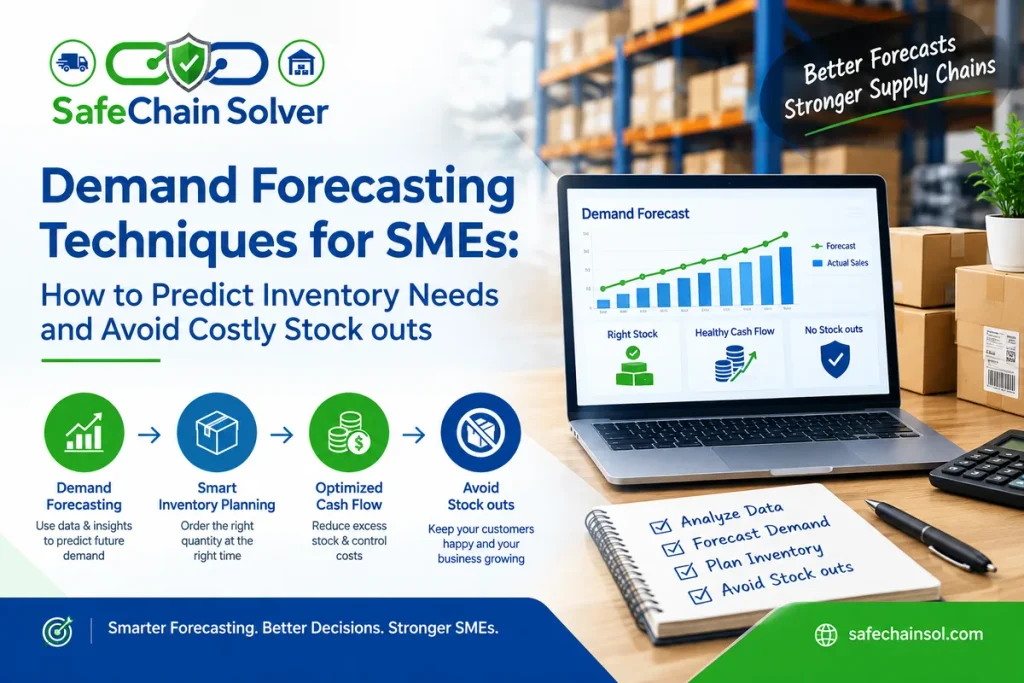
Customer demand forecasting is one of the most significant challenges small and medium-sized enterprises (SMEs) face. Every purchasing decision affects two critical areas of the business: inventory availability and cash flow. Ordering too much stock ties up valuable working capital, increases storage and holding costs, and can eventually create obsolete or slow-moving inventory. On the other hand, ordering too little can cause stock outs, lost sales, production delays, and dissatisfied customers.
For SMEs operating with tighter budgets and limited resources, effective demand forecasting techniques can provide a practical way to balance these competing pressures. Forecasting does not require an expensive enterprise resource planning (ERP) system or sophisticated artificial intelligence platform. Even a structured spreadsheet using historical sales data, seasonal patterns, supplier lead times, and inventory performance can significantly improve purchasing decisions.
The objective is not to predict demand with perfect accuracy. Instead, the goal is to make better purchasing and inventory decisions using the best information available.
According to the Association for Supply Chain Management (ASCM), effective forecasting and planning are important components of supply chain performance. For SMEs, improving forecast accuracy can help reduce unnecessary inventory while supporting better product availability.
Table of Contents
Why Demand Forecasting Matters for SME Cash Flow
Inventory represents cash that has already been spent but has not yet generated revenue. When excessive inventory accumulates, a business may appear financially healthy on paper while a significant amount of working capital is sitting on warehouse shelves.
Consider an SME that purchases $50,000 of inventory based on an optimistic sales expectation. If only $30,000 sells within the expected period, $20,000 remains tied up in stock. The business may then need additional cash to purchase faster-moving products, pay suppliers, cover operating expenses, or respond to new customer opportunities.
Effective demand forecasting helps businesses answer three practical questions:
- What products are customers likely to need?
- How much inventory should we purchase?
- When should we place the order?
The answers become more reliable when demand forecasting is connected with inventory analysis, supplier lead times, safety stock, and actual sales performance. You can peek into Free Tools at Safe Chain Solver.
If your business struggles with excess inventory, stock outs, or uncertain purchasing decisions, Safe Chain Solver provides practical supply chain tools and consulting support designed for SMEs.
Core Demand Forecasting Methods for SMEs
There is no single demand forecasting method that works for every business. SMEs should select an approach based on the availability and reliability of their data.
Qualitative Forecasting Methods
Qualitative methods rely primarily on human expertise, market knowledge, customer feedback, and industry experience. They are particularly useful when historical sales data is limited.
Sales Force Composite
Sales representatives regularly communicate with customers and may have early visibility into upcoming orders, market changes, customer preferences, and competitor activity.
Collecting this information from the sales team can provide valuable insight into future demand. However, management should compare sales forecasts with actual historical performance because individual estimates can sometimes be overly optimistic.
Expert Judgment
Experienced managers, buyers, industry specialists, and supply chain professionals can assess market conditions that may not appear in historical data.
For example, a business launching a new product may have no previous sales history. Management may therefore need to combine market research, customer feedback, competitor activity, and expert judgment to establish an initial forecast.
Quantitative Forecasting Methods
Quantitative methods use historical sales data to identify patterns and estimate future demand. These approaches are especially useful for established products with relatively consistent sales history.
Simple Moving Average
A simple moving average calculates the average demand over a defined historical period.
For example, if monthly sales were:
- January: 900 units
- February: 1,000 units
- March: 1,100 units
The three-month moving average would be:
(900 + 1,000 + 1,100) ÷ 3 = 1,000 units
The business could use 1,000 units as a starting point for the next month’s forecast.
The advantage is simplicity. The disadvantage is that older data receives the same weight as newer information.
Weighted Moving Average
A weighted moving average gives greater importance to more recent sales periods.
For example, management may assign:
- January: 20%
- February: 30%
- March: 50%
If demand has been increasing, this method can respond more quickly than a simple moving average.
Exponential Smoothing
Exponential smoothing applies a smoothing factor to balance historical demand with the latest actual demand.
It can be useful when demand changes gradually but the business still wants the forecast to respond to recent fluctuations.
For SMEs, the important point is not necessarily choosing the most sophisticated mathematical method. A simple forecasting model that is consistently maintained and reviewed can be more valuable than a complex model based on unreliable data.
Key Considerations for More Accurate Demand Forecasting
Forecast accuracy depends on more than selecting a forecasting formula.
1. Account for Seasonality
Some products experience predictable changes throughout the year.
Examples include:
- School and educational supplies
- Cooling and heating equipment
- Holiday-related products
- Agricultural supplies
- Construction materials
- Certain food and beverage products
Review previous years’ sales to identify recurring seasonal patterns. If demand normally increases by 30% during a particular period, ignoring that pattern can result in serious stock shortages.
2. Consider Supplier Lead Times
A forecast tells you what customers may purchase, but purchasing decisions also depend on how long suppliers take to deliver.
A product with a 60-day supplier lead time requires a different replenishment strategy from a product that can be delivered within three days.
Forecasting should therefore be connected with supplier lead-time data, minimum order quantities, order frequency, and supplier reliability.
3. Integrate Safety Stock
Even a good forecast cannot eliminate uncertainty.
Unexpected demand increases, supplier delays, transportation disruptions, and quality problems can create shortages. Safety stock provides an additional buffer against these uncertainties.
Businesses should avoid simply adding an arbitrary percentage to every product. Safety stock should be calculated according to demand variability and supplier lead-time variability.
See our guide on How to Calculate Safety Stock for SMEs for a practical approach.
4. Identify Slow-Moving Inventory Early
Demand forecasting should not stop after a purchase order is created. Businesses should continuously compare forecasted demand with actual consumption.
If an item repeatedly sells below forecast, purchasing quantities should be reassessed.
This is particularly important for SLOB inventory (slow-moving and obsolete inventory). Once inventory becomes stagnant, the business may have to discount it, return it to suppliers, repurpose it, or write it off.
Read our guide on SLOB Inventory: Meaning, Analysis and Management to understand how businesses can identify and control stagnant stock.
5. Measure Forecast Accuracy
A forecast should be measured against actual demand.
For example:
Forecast = 1,000 units
Actual demand = 900 units
The business should investigate why the forecast was higher than actual demand.
Was there an unexpected market slowdown? Did a major customer delay an order? Was the historical data abnormal? Did sales provide an overly optimistic estimate?
Regular forecast Vs actual reviews help organizations improve their future forecasts instead of repeatedly making the same assumptions.
Connect Forecasting with Inventory Decisions
Demand forecasting becomes much more powerful when it is connected to other inventory management techniques.
A practical SME inventory planning process can look like this:
Historical Sales → Demand Forecast → Lead-Time Review → Safety Stock → Reorder Point → Purchase Decision → Actual Demand Review
This creates a continuous feedback loop.
For example, if forecasted monthly demand is 1,000 units, supplier lead time is 30 days, and the business maintains an appropriate safety stock level, the purchasing team can establish a more disciplined replenishment strategy instead of ordering based solely on intuition.
SMEs can also combine demand forecasting with inventory turnover analysis to identify products that consume working capital too slowly.
Improve Purchasing Through Supplier Performance Management
Forecasting accuracy can be undermined by unreliable suppliers.
Suppose demand is forecast correctly at 1,000 units, but the supplier consistently delivers two weeks late. The business may still experience stockouts even though its demand forecast was accurate.
This is why supplier performance should be monitored alongside demand planning.
A structured Vendor Scorecard Framework can help SMEs evaluate suppliers using factors such as:
- On-time delivery
- Product quality
- Lead-time reliability
- Price competitiveness
- Order fulfillment
- Responsiveness
- Compliance
Better supplier data allows purchasing teams to make more realistic replenishment decisions.
A Practical Demand Forecasting Routine for SMEs
SMEs do not necessarily need a sophisticated forecasting department. A simple monthly process can produce meaningful improvements.
Step 1: Collect Sales Data
Gather at least several months of reliable sales history where available.
Step 2: Identify Patterns
Look for increasing demand, declining demand, seasonal fluctuations, unusual spikes, and slow-moving products.
Step 3: Select a Forecasting Method
Use a simple moving average, weighted moving average, exponential smoothing, or a qualitative approach depending on the available data.
Step 4: Review Inventory Position
Check current stock, open purchase orders, committed inventory, safety stock, and supplier lead times.
Step 5: Calculate the Purchasing Requirement
Avoid ordering simply because inventory “looks low.” Compare expected demand against available and incoming stock.
Step 6: Compare Forecast Against Actual Demand
At the end of each period, measure forecast performance and adjust the model where necessary.
Step 7: Repeat the Process
Forecasting is not a one-time exercise. Regular updates make the process increasingly useful as more reliable data becomes available.
Driving SME Growth Through Demand Forecasting Accuracy
Effective demand forecasting is ultimately about more than predicting sales. It is about protecting working capital while maintaining customer service.
When businesses transition from reactive purchasing to proactive demand planning, they can reduce unnecessary inventory, improve stock availability, strengthen purchasing discipline, and make better use of limited cash resources.
The strongest results come when forecasting is integrated with inventory turnover, safety stock, reorder points, warehouse performance, and supplier management.
SMEs do not need perfect forecasts. They need a repeatable, data-driven process that continuously improves.
Need Better Inventory and Supply Chain Control?
If your business is struggling with excess stock, stockouts, poor inventory visibility, or inconsistent purchasing decisions, Safe Chain Solver can help you turn supply chain data into practical management decisions.
Explore our Inventory & Supply Chain Tools or contact Safe Chain Solver for practical support in inventory optimization, procurement, warehousing, and supply chain improvement.
Conclusion
Balancing inventory and cash flow requires a disciplined approach to demand forecasting. Buying too much inventory can lock valuable cash into slow-moving stock, while buying too little can create stockouts and lost revenue.
By combining historical sales data with qualitative market intelligence, seasonal analysis, supplier lead times, safety stock, inventory performance, and regular forecast reviews, SMEs can make purchasing decisions with greater confidence.
The objective is not to eliminate uncertainty. The objective is to manage uncertainty better.
A practical forecasting process gives SMEs greater visibility into future demand, helps protect working capital, and creates a stronger foundation for sustainable supply chain performance.